I built this because compliance teams were spending two days every quarter manually comparing policy documents — printing them out, highlighting changes, and writing narratives for auditors. The work wasn't intellectually hard. It was just brutally slow and error-prone.
Here's the scenario I see repeatedly: A company operates under multiple regulatory frameworks — ISO 27001, SOC 2, GDPR, or industry-specific regulations like APRA CPS 234 for Australian financial services. When a regulator releases an updated guidance document, or when the internal security team revises the Acceptable Use Policy, someone has to figure out what changed, assess the compliance impact, and write it all up in a format auditors will accept.
Manual diffing of 60-page Word documents is miserable. Keyword search misses semantic intent. And when an auditor asks "show me the evidence that you reviewed and acted on Policy Version 2.3," the response is usually a panicked hunt through email threads.
What I built is a system that watches for policy document changes, runs a semantic comparison using GPT-4o to understand what the change means (not just what text shifted), assesses compliance impact, and writes an immutable audit trail entry that you can actually show a regulator. This article covers the full implementation — state models, orchestration, semantic diffing, audit integrity, cost analysis, and when this approach makes no sense.
What You'll Learn
- How to build a semantic policy diff engine that detects meaningful changes, not cosmetic text edits
- Orchestrating multi-step compliance workflows with LangGraph (Python) and Semantic Kernel (C#)
- Maintaining a tamper-evident audit trail using Azure Cosmos DB append-only patterns
- Real cost numbers: what it actually costs to monitor 50 policy documents monthly with GPT-4o
- Observability and debugging techniques for AI compliance pipelines in production
Current Approach & Its Limitations
Before building anything, I spent time understanding how compliance teams actually work today. The baseline is almost universally the same: a combination of SharePoint for document storage, email for change notifications, Word's track changes feature for diffing, and a spreadsheet to record what was reviewed and when.
This approach has three compounding problems:
Problem 1: Syntactic Diffing Misses Semantic Impact
Track Changes tells you that "employees must use MFA" became "employees should use MFA." What it doesn't tell you is that this single word change may constitute a material weakening of a security control that your ISO 27001 certification depends on. Word's diff engine is blind to meaning.
Problem 2: The Audit Trail Is Fragmented and Mutable
When you record a compliance review in a spreadsheet, that record is editable. An auditor with any sophistication will ask: "How do I know this wasn't backdated?" When the audit trail lives in email, it's scattered across inboxes and can't be searched or aggregated. The tricky part is that regulators don't just want evidence of what you did — they want evidence that the evidence itself hasn't been tampered with.
Problem 3: Volume Scales Linearly with Human Hours
A mid-size financial services firm might maintain 80–120 active policy documents across multiple regulatory frameworks. When regulators update their guidance — and APRA, ASIC, and ISO committees update them constantly — each update requires human review time. At 2–4 hours per policy review, a busy quarter can consume hundreds of hours of skilled compliance staff time.
The Cost Before Automation
At an average fully-loaded cost of $120/hour for a compliance analyst, 200 hours per quarter of manual policy review equals $96,000/year in labour for this one task alone. That's before you factor in the cost of a missed change.
The Solution Approach
The system I built has three core behaviours. First, it detects when a policy document has changed — not just that the file was touched, but that the content has meaningfully changed. Second, it uses GPT-4o to understand what changed and why it matters from a compliance perspective. Third, it writes an append-only audit record with a cryptographic hash chain so any tampering is detectable.
The tech stack is deliberately boring:
- Azure Blob Storage — versioned storage for policy documents, with immutable storage policies for audit records
- Azure OpenAI (GPT-4o) — semantic analysis, compliance impact assessment, and report generation
- Azure AI Search — indexed policy corpus for context retrieval during compliance checks
- Azure Cosmos DB — append-only audit log with optimistic concurrency controls
- LangGraph (Python) or Semantic Kernel (C#) — orchestrating the multi-step analysis workflow
- Azure Functions — event-driven trigger when Blob Storage detects new policy versions
Why Not a Vector Database for the Audit Trail?
Vector stores are optimised for similarity search, not for provenance and integrity. An audit trail needs exact retrieval, sequential ordering, and tamper evidence. Cosmos DB with a hash chain gives you all three. Pinecone does not.
Architecture Overview
The architecture is event-driven. When a new policy document version arrives in Azure Blob Storage, an Azure Function triggers the compliance orchestrator. The orchestrator is a LangGraph state machine (Python) or a Semantic Kernel process (C#) that walks through five stages: ingest, classify, diff, assess, and record.
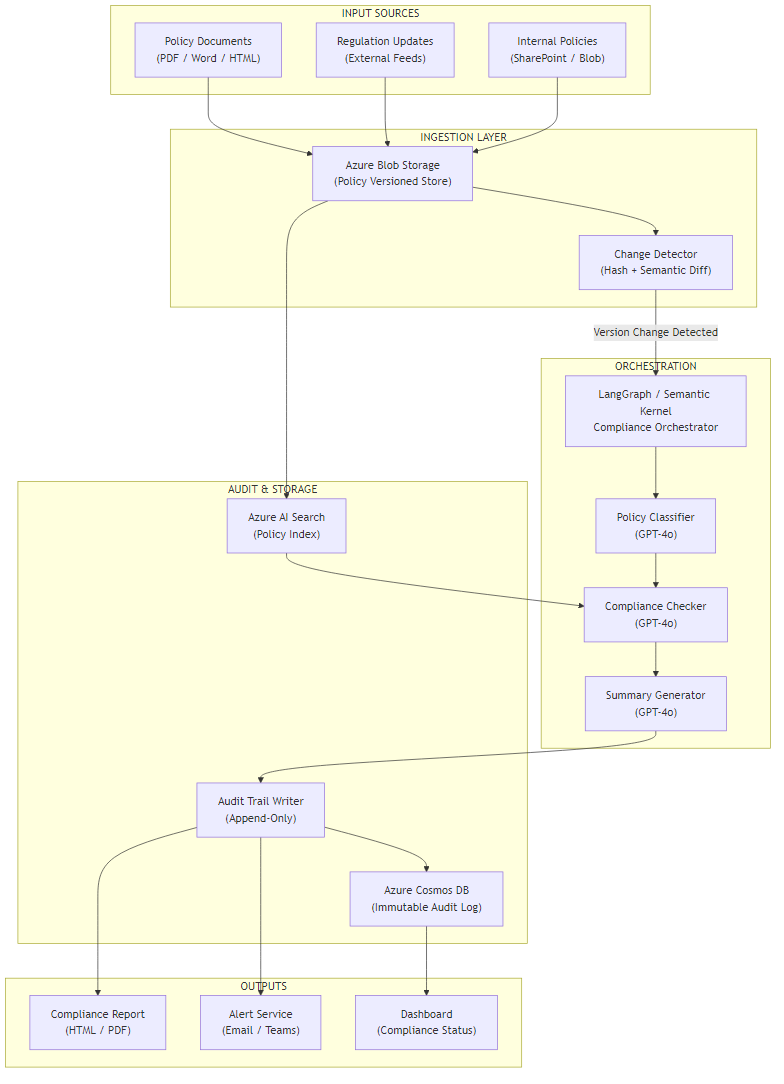
The key design decisions in this architecture:
- Blob Storage versioning — every policy document version is retained. The system never overwrites; it always appends a new version. This means you can reconstruct the full history of any document at any point in time.
- Semantic diff before GPT-4o call — a hash comparison runs first. If the document hash hasn't changed, no GPT-4o call is made. This alone eliminates most of the cost for a corpus that changes infrequently.
- Azure AI Search for context — when assessing a policy change, the compliance checker pulls related policies from the index to assess cross-document impact. A change to the Data Classification Policy may implicitly affect the Acceptable Use Policy and the Data Retention Policy.
- Cosmos DB with optimistic concurrency — audit records are written with an ETag-based optimistic lock. A concurrent write will fail rather than silently overwrite, making the trail reliable under load.
Core Implementation
State Model
The state model carries a policy document through the pipeline. In Python with LangGraph, state is a TypedDict. In C# with Semantic Kernel, it's a plain class. Both carry the same fields.
from typing import TypedDict, Optional, List
from dataclasses import dataclass
from datetime import datetime

class PolicyVersion(TypedDict):
    blob_url: str
    version_id: str
    content_hash: str
    extracted_text: str
    upload_timestamp: str

class PolicyChange(TypedDict):
    section: str
    change_type: str          # "addition" | "removal" | "modification"
    original_text: str
    new_text: str
    semantic_summary: str

class ComplianceAssessment(TypedDict):
    risk_level: str           # "critical" | "high" | "medium" | "low" | "informational"
    affected_frameworks: List[str]
    affected_controls: List[str]
    action_required: bool
    action_description: str
    reviewer_notes: str

class ComplianceState(TypedDict):
    policy_id: str
    policy_name: str
    previous_version: Optional[PolicyVersion]
    current_version: PolicyVersion
    detected_changes: List[PolicyChange]
    assessment: Optional[ComplianceAssessment]
    audit_record_id: Optional[str]
    processing_stage: str
    error: Optional[str]
public record PolicyVersion(
string BlobUrl,
string VersionId,
string ContentHash,
string ExtractedText,
DateTimeOffset UploadTimestamp
);
public record PolicyChange(
string Section,
string ChangeType, // "addition" | "removal" | "modification"
string OriginalText,
string NewText,
string SemanticSummary
);
public record ComplianceAssessment(
string RiskLevel, // "critical" | "high" | "medium" | "low" | "informational"
List<string> AffectedFrameworks,
List<string> AffectedControls,
bool ActionRequired,
string ActionDescription,
string ReviewerNotes
);
public class ComplianceState
{
public string PolicyId { get; set; } = string.Empty;
public string PolicyName { get; set; } = string.Empty;
public PolicyVersion? PreviousVersion { get; set; }
public PolicyVersion CurrentVersion { get; set; } = null!;
public List<PolicyChange> DetectedChanges { get; set; } = new();
public ComplianceAssessment? Assessment { get; set; }
public string? AuditRecordId { get; set; }
public string ProcessingStage { get; set; } = "initialised";
public string? Error { get; set; }
}Orchestration Pipeline
The orchestrator defines the nodes and the conditional routing. Here's what surprised me: the routing logic is the most important part. A policy document with no meaningful changes should exit the pipeline after the diff stage without ever touching GPT-4o for the assessment. This is where most of the cost savings come from.
from langgraph.graph import StateGraph, END
from typing import Literal

def route_after_diff(state: ComplianceState) -> Literal["assess", "record_no_change"]:
    """Skip assessment if no meaningful changes detected."""
    if not state["detected_changes"]:
        return "record_no_change"
    return "assess"

def route_after_assessment(state: ComplianceState) -> Literal["write_audit", "error"]:
    if state.get("error"):
        return "error"
    return "write_audit"

def build_compliance_graph():
    graph = StateGraph(ComplianceState)

    graph.add_node("ingest", ingest_policy_document)
    graph.add_node("classify", classify_policy_type)
    graph.add_node("diff", semantic_diff_policy)
    graph.add_node("assess", assess_compliance_impact)
    graph.add_node("write_audit", write_audit_record)
    graph.add_node("record_no_change", record_no_change_event)

    graph.set_entry_point("ingest")
    graph.add_edge("ingest", "classify")
    graph.add_edge("classify", "diff")
    graph.add_conditional_edges("diff", route_after_diff)
    graph.add_conditional_edges("assess", route_after_assessment)
    graph.add_edge("write_audit", END)
    graph.add_edge("record_no_change", END)

    return graph.compile()

compliance_graph = build_compliance_graph()
using Microsoft.SemanticKernel;
using Microsoft.SemanticKernel.Process;
public class CompliancePipelineProcess
{
public static KernelProcess BuildProcess()
{
var processBuilder = new ProcessBuilder("ComplianceAuditPipeline");
var ingestStep = processBuilder.AddStepFromType<IngestPolicyStep>();
var classifyStep = processBuilder.AddStepFromType<ClassifyPolicyStep>();
var diffStep = processBuilder.AddStepFromType<SemanticDiffStep>();
var assessStep = processBuilder.AddStepFromType<AssessComplianceStep>();
var auditStep = processBuilder.AddStepFromType<WriteAuditRecordStep>();
var noChangeStep = processBuilder.AddStepFromType<RecordNoChangeStep>();
processBuilder
.OnInputEvent(ComplianceEvents.PolicyVersionDetected)
.SendEventTo(new ProcessFunctionTargetBuilder(ingestStep));
ingestStep
.OnFunctionResult(nameof(IngestPolicyStep.IngestAsync))
.SendEventTo(new ProcessFunctionTargetBuilder(classifyStep));
classifyStep
.OnFunctionResult(nameof(ClassifyPolicyStep.ClassifyAsync))
.SendEventTo(new ProcessFunctionTargetBuilder(diffStep));
// Conditional routing after diff
diffStep
.OnEvent(ComplianceEvents.ChangesDetected)
.SendEventTo(new ProcessFunctionTargetBuilder(assessStep));
diffStep
.OnEvent(ComplianceEvents.NoChangesDetected)
.SendEventTo(new ProcessFunctionTargetBuilder(noChangeStep));
assessStep
.OnFunctionResult(nameof(AssessComplianceStep.AssessAsync))
.SendEventTo(new ProcessFunctionTargetBuilder(auditStep));
return processBuilder.Build();
}
}Key Technical Challenge: Semantic Policy Diffing
The tricky part is teaching the system the difference between "someone fixed a typo" and "someone changed a SHALL to a SHOULD in a security control clause." Both look the same to a text diff. They have completely different compliance implications.
My approach is a two-pass diff. The first pass is a structural diff — I split the document into sections by heading, then compare section-by-section using a fast Levenshtein ratio. Sections with similarity above 0.97 are flagged as "no meaningful change" and never sent to GPT-4o. Sections below that threshold are sent to GPT-4o with a structured prompt that asks for the semantic significance.
from difflib import SequenceMatcher
from openai import AzureOpenAI
import re
from typing import List

CHANGE_SIMILARITY_THRESHOLD = 0.97

def split_into_sections(text: str) -> dict[str, str]:
    """Split policy document by headings."""
    sections = {}
    current_heading = "_preamble"
    current_content = []

    for line in text.split("\n"):
        heading_match = re.match(r'^#{1,4}\s+(.+)$', line)
        if heading_match:
            if current_content:
                sections[current_heading] = "\n".join(current_content)
            current_heading = heading_match.group(1).strip()
            current_content = []
        else:
            current_content.append(line)

    if current_content:
        sections[current_heading] = "\n".join(current_content)
    return sections

def quick_similarity(a: str, b: str) -> float:
    return SequenceMatcher(None, a, b).ratio()

async def semantic_diff_policy(state: ComplianceState) -> ComplianceState:
    if not state["previous_version"]:
        # First time we've seen this policy — no diff to compute
        return {**state, "detected_changes": [], "processing_stage": "diff_complete"}

    prev_sections = split_into_sections(state["previous_version"]["extracted_text"])
    curr_sections = split_into_sections(state["current_version"]["extracted_text"])

    candidate_changes = []
    all_headings = set(prev_sections) | set(curr_sections)

    for heading in all_headings:
        prev_text = prev_sections.get(heading, "")
        curr_text = curr_sections.get(heading, "")

        if quick_similarity(prev_text, curr_text) >= CHANGE_SIMILARITY_THRESHOLD:
            continue  # No meaningful change — skip GPT-4o call

        candidate_changes.append({
            "section": heading,
            "original": prev_text,
            "current": curr_text
        })

    if not candidate_changes:
        return {**state, "detected_changes": [], "processing_stage": "diff_complete"}

    # GPT-4o call only for sections that actually changed
    meaningful_changes = await analyse_changes_with_gpt4o(candidate_changes, state["policy_name"])
    return {**state, "detected_changes": meaningful_changes, "processing_stage": "diff_complete"}

async def analyse_changes_with_gpt4o(
    candidates: list,
    policy_name: str
) -> List[PolicyChange]:
    client = AzureOpenAI(
        azure_endpoint=os.getenv("AZURE_OPENAI_ENDPOINT"),
        api_key=os.getenv("AZURE_OPENAI_API_KEY"),
        api_version="2024-08-01-preview"
    )

    changes = []
    for candidate in candidates:
        prompt = f"""You are a compliance expert reviewing changes to a corporate policy document.

Policy: {policy_name}
Section: {candidate['section']}

PREVIOUS TEXT:
{candidate['original'][:2000]}

CURRENT TEXT:
{candidate['current'][:2000]}

Analyse this change and respond in JSON:
{{
  "change_type": "addition|removal|modification",
  "semantic_summary": "Plain English explanation of what changed and why it might matter",
  "compliance_significance": "high|medium|low|cosmetic"
}}

If the change is purely cosmetic (formatting, spelling corrections with no meaning change), set compliance_significance to "cosmetic"."""

        response = client.chat.completions.create(
            model="gpt-4o",
            messages=[{"role": "user", "content": prompt}],
            response_format={"type": "json_object"},
            temperature=0
        )

        result = json.loads(response.choices[0].message.content)
        if result.get("compliance_significance") != "cosmetic":
            changes.append(PolicyChange(
                section=candidate["section"],
                change_type=result["change_type"],
                original_text=candidate["original"],
                new_text=candidate["current"],
                semantic_summary=result["semantic_summary"]
            ))

    return changes
using Microsoft.SemanticKernel;
using Microsoft.SemanticKernel.Process;
using System.Text.Json;
using System.Text.RegularExpressions;
public class SemanticDiffStep : KernelProcessStep<ComplianceState>
{
private const double ChangeSimilarityThreshold = 0.97;
[KernelFunction]
public async Task<ComplianceState> DiffAsync(
KernelProcessStepContext context,
ComplianceState state,
Kernel kernel)
{
if (state.PreviousVersion == null)
{
await context.EmitEventAsync(ComplianceEvents.NoChangesDetected);
return state with { ProcessingStage = "diff_complete" };
}
var prevSections = SplitIntoSections(state.PreviousVersion.ExtractedText);
var currSections = SplitIntoSections(state.CurrentVersion.ExtractedText);
var allHeadings = prevSections.Keys.Union(currSections.Keys).ToHashSet();
var candidates = allHeadings
.Select(h => new {
Heading = h,
Original = prevSections.GetValueOrDefault(h, ""),
Current = currSections.GetValueOrDefault(h, "")
})
.Where(c => QuickSimilarity(c.Original, c.Current) < ChangeSimilarityThreshold)
.ToList();
if (!candidates.Any())
{
await context.EmitEventAsync(ComplianceEvents.NoChangesDetected);
return state with { ProcessingStage = "diff_complete" };
}
var changes = new List<PolicyChange>();
foreach (var candidate in candidates)
{
var change = await AnalyseChangeWithGpt4oAsync(
kernel, candidate.Heading, candidate.Original, candidate.Current, state.PolicyName);
if (change != null) changes.Add(change);
}
state.DetectedChanges = changes;
state.ProcessingStage = "diff_complete";
if (changes.Any())
await context.EmitEventAsync(ComplianceEvents.ChangesDetected);
else
await context.EmitEventAsync(ComplianceEvents.NoChangesDetected);
return state;
}
private async Task<PolicyChange?> AnalyseChangeWithGpt4oAsync(
Kernel kernel, string section, string original, string current, string policyName)
{
var prompt = $"""
You are a compliance expert reviewing changes to a corporate policy document.
Policy: {policyName}
Section: {section}
PREVIOUS TEXT:
{original[..Math.Min(2000, original.Length)]}
CURRENT TEXT:
{current[..Math.Min(2000, current.Length)]}
Analyse and respond in JSON:
{{
"change_type": "addition|removal|modification",
"semantic_summary": "Plain English explanation of the change and compliance significance",
"compliance_significance": "high|medium|low|cosmetic"
}}
""";
var result = await kernel.InvokePromptAsync<string>(prompt);
var parsed = JsonSerializer.Deserialize<JsonElement>(result!);
if (parsed.GetProperty("compliance_significance").GetString() == "cosmetic")
return null;
return new PolicyChange(
Section: section,
ChangeType: parsed.GetProperty("change_type").GetString()!,
OriginalText: original,
NewText: current,
SemanticSummary: parsed.GetProperty("semantic_summary").GetString()!
);
}
private static double QuickSimilarity(string a, string b)
{
if (string.IsNullOrEmpty(a) && string.IsNullOrEmpty(b)) return 1.0;
if (string.IsNullOrEmpty(a) || string.IsNullOrEmpty(b)) return 0.0;
var longer = a.Length > b.Length ? a : b;
var shorter = a.Length > b.Length ? b : a;
var editDistance = LevenshteinDistance(longer, shorter);
return (longer.Length - editDistance) / (double)longer.Length;
}
private static Dictionary<string, string> SplitIntoSections(string text)
{
var sections = new Dictionary<string, string>();
var currentHeading = "_preamble";
var currentContent = new List<string>();
foreach (var line in text.Split('\n'))
{
var match = Regex.Match(line, @"^#{1,4}\s+(.+)$");
if (match.Success)
{
if (currentContent.Any())
sections[currentHeading] = string.Join('\n', currentContent);
currentHeading = match.Groups[1].Value.Trim();
currentContent.Clear();
}
else
{
currentContent.Add(line);
}
}
if (currentContent.Any())
sections[currentHeading] = string.Join('\n', currentContent);
return sections;
}
}Key Technical Challenge: Tamper-Evident Audit Trail
Here's what surprised me during the initial design: most developers reach for a relational database for audit logs and add a "created_at" timestamp. That's not an audit trail — that's a log table. A genuine audit trail needs two properties: every record must be immutable after writing, and a sophisticated reviewer must be able to detect if any record has been altered or deleted.
I implemented a hash chain. Each audit record contains the SHA-256 hash of the previous record. This means that if you alter or delete any record in the chain, all subsequent records become invalid. Auditors can verify chain integrity by re-computing hashes forward from a known-good anchor.
import hashlib
import json
import uuid
from azure.cosmos import CosmosClient
from datetime import datetime, timezone

COSMOS_ENDPOINT = os.getenv("COSMOS_ENDPOINT")
COSMOS_KEY = os.getenv("COSMOS_KEY")
DATABASE_NAME = "compliance"
CONTAINER_NAME = "audit_trail"

def compute_record_hash(record: dict) -> str:
    """Deterministic hash of immutable record fields."""
    hashable = {
        "id": record["id"],
        "policy_id": record["policy_id"],
        "policy_version_id": record["policy_version_id"],
        "timestamp": record["timestamp"],
        "changes": record["changes"],
        "assessment": record["assessment"],
        "previous_record_hash": record["previous_record_hash"]
    }
    canonical = json.dumps(hashable, sort_keys=True, ensure_ascii=True)
    return hashlib.sha256(canonical.encode()).hexdigest()

async def write_audit_record(state: ComplianceState) -> ComplianceState:
    client = CosmosClient(COSMOS_ENDPOINT, credential=COSMOS_KEY)
    container = client.get_database_client(DATABASE_NAME).get_container_client(CONTAINER_NAME)

    # Get the hash of the most recent record for this policy
    previous_hash = await get_latest_record_hash(container, state["policy_id"])

    record_id = str(uuid.uuid4())
    timestamp = datetime.now(timezone.utc).isoformat()

    record = {
        "id": record_id,
        "policy_id": state["policy_id"],
        "policy_name": state["policy_name"],
        "policy_version_id": state["current_version"]["version_id"],
        "timestamp": timestamp,
        "changes": state["detected_changes"],
        "assessment": state.get("assessment"),
        "previous_record_hash": previous_hash,
        "record_hash": None  # Will be set after computing
    }

    record["record_hash"] = compute_record_hash(record)

    # Cosmos DB upsert with optimistic concurrency (etag: "*" means new record only)
    await container.create_item(body=record)
    return {**state, "audit_record_id": record_id, "processing_stage": "complete"}

async def get_latest_record_hash(container, policy_id: str) -> str:
    """Return hash of most recent audit record, or 'GENESIS' for the first."""
    query = """
        SELECT TOP 1 c.record_hash
        FROM c
        WHERE c.policy_id = @policy_id
        ORDER BY c.timestamp DESC
    """
    items = list(container.query_items(
        query=query,
        parameters=[{"name": "@policy_id", "value": policy_id}],
        enable_cross_partition_query=True
    ))
    return items[0]["record_hash"] if items else "GENESIS"
using Microsoft.Azure.Cosmos;
using System.Security.Cryptography;
using System.Text;
using System.Text.Json;
public class WriteAuditRecordStep : KernelProcessStep<ComplianceState>
{
private readonly CosmosClient _cosmosClient;
private readonly Container _container;
public WriteAuditRecordStep(IOptions<CosmosOptions> options)
{
_cosmosClient = new CosmosClient(options.Value.Endpoint, options.Value.Key);
_container = _cosmosClient
.GetDatabase("compliance")
.GetContainer("audit_trail");
}
[KernelFunction]
public async Task<ComplianceState> WriteAsync(
KernelProcessStepContext context, ComplianceState state)
{
var previousHash = await GetLatestRecordHashAsync(state.PolicyId);
var recordId = Guid.NewGuid().ToString();
var timestamp = DateTimeOffset.UtcNow.ToString("O");
var record = new AuditRecord
{
Id = recordId,
PolicyId = state.PolicyId,
PolicyName = state.PolicyName,
PolicyVersionId = state.CurrentVersion.VersionId,
Timestamp = timestamp,
Changes = state.DetectedChanges,
Assessment = state.Assessment,
PreviousRecordHash = previousHash,
RecordHash = string.Empty // Computed below
};
record.RecordHash = ComputeRecordHash(record);
await _container.CreateItemAsync(record, new PartitionKey(state.PolicyId));
state.AuditRecordId = recordId;
state.ProcessingStage = "complete";
return state;
}
private string ComputeRecordHash(AuditRecord record)
{
var hashable = new
{
record.Id, record.PolicyId, record.PolicyVersionId,
record.Timestamp, record.Changes, record.Assessment,
record.PreviousRecordHash
};
var canonical = JsonSerializer.Serialize(hashable,
new JsonSerializerOptions { PropertyNamingPolicy = JsonNamingPolicy.CamelCase });
var bytes = SHA256.HashData(Encoding.UTF8.GetBytes(canonical));
return Convert.ToHexString(bytes).ToLowerInvariant();
}
private async Task<string> GetLatestRecordHashAsync(string policyId)
{
var query = new QueryDefinition(
"SELECT TOP 1 c.recordHash FROM c WHERE c.policyId = @policyId ORDER BY c.timestamp DESC")
.WithParameter("@policyId", policyId);
using var iterator = _container.GetItemQueryIterator<JsonElement>(query);
if (iterator.HasMoreResults)
{
var page = await iterator.ReadNextAsync();
var first = page.FirstOrDefault();
if (first.ValueKind != JsonValueKind.Undefined)
return first.GetProperty("recordHash").GetString() ?? "GENESIS";
}
return "GENESIS";
}
}Verifying the Hash Chain
Write a separate verification utility that reads all records for a policy in timestamp order and re-computes each hash, comparing it to the stored record_hash. Any mismatch indicates tampering. Run this as a scheduled Azure Function and alert on any chain break.
Cost Analysis
In practice, the costs are far lower than you'd expect because of the early-exit pattern. Here are real numbers from a deployment monitoring 60 policy documents monthly.
| Scenario | Token Usage | GPT-4o Cost | Frequency | Monthly Cost |
|---|---|---|---|---|
| Policy document unchanged (hash match) | 0 tokens | $0.00 | ~85% of checks | $0.00 |
| Cosmetic edits only (all sections above threshold) | ~500 tokens | $0.003 | ~10% of checks | $0.02 |
| Meaningful policy change (2–4 changed sections) | ~8,000 tokens | $0.05 | ~4% of checks | $0.12 |
| Major policy overhaul (10+ changed sections) | ~25,000 tokens | $0.16 | ~1% of checks | $0.10 |
Total GPT-4o cost for 60 policies monitored weekly (240 checks/month): approximately $0.24/month. The infrastructure costs dwarf the AI costs:
| Service | Approximate Monthly Cost | Notes |
|---|---|---|
| Azure Blob Storage (versioned) | $2–5 | 60 documents, 10 versions each, avg 2MB/doc |
| Azure Cosmos DB (serverless) | $3–8 | Audit records with query, serverless tier |
| Azure AI Search (Free tier) | $0 | Up to 50MB index, fine for this use case |
| Azure Functions (Consumption) | $0–1 | First 1M executions free |
| Azure OpenAI (GPT-4o) | $0.24 | As computed above |
| Total | ~$10–15/month | For 60 policies, monitored weekly |
The ROI Calculation
$15/month in infrastructure versus $96,000/year in manual review labour. Even if automation only handles 60% of the review work and humans still review the AI's output, the payback period is measured in days, not months.
Observability & Debugging
The hardest part of running an AI compliance pipeline isn't the AI — it's explaining to a sceptical compliance officer why the system flagged a change as "high risk" last Tuesday. You need complete explainability for every decision the system makes.
Structured Logging Every Stage
Every node in the LangGraph graph emits a structured log entry with the policy ID, stage name, duration, token usage, and the model's reasoning. This goes to Azure Application Insights via the OpenTelemetry SDK.
from opentelemetry import trace
from opentelemetry.sdk.trace import TracerProvider
from opentelemetry.sdk.trace.export import BatchSpanProcessor
from azure.monitor.opentelemetry.exporter import AzureMonitorTraceExporter
import functools, time

tracer_provider = TracerProvider()
tracer_provider.add_span_processor(
    BatchSpanProcessor(AzureMonitorTraceExporter(
        connection_string=os.getenv("APPLICATIONINSIGHTS_CONNECTION_STRING")
    ))
)
trace.set_tracer_provider(tracer_provider)
tracer = trace.get_tracer("compliance.pipeline")

def trace_stage(stage_name: str):
    def decorator(func):
        @functools.wraps(func)
        async def wrapper(state: ComplianceState, *args, **kwargs):
            with tracer.start_as_current_span(stage_name) as span:
                span.set_attribute("policy.id", state.get("policy_id", "unknown"))
                span.set_attribute("policy.name", state.get("policy_name", "unknown"))
                start = time.monotonic()
                try:
                    result = await func(state, *args, **kwargs)
                    span.set_attribute("stage.duration_ms", int((time.monotonic() - start) * 1000))
                    span.set_attribute("stage.changes_detected", len(result.get("detected_changes", [])))
                    return result
                except Exception as e:
                    span.record_exception(e)
                    span.set_status(trace.StatusCode.ERROR, str(e))
                    raise
        return wrapper
    return decorator

@trace_stage("semantic_diff")
async def semantic_diff_policy(state: ComplianceState) -> ComplianceState:
    # ... implementation above
    pass
using Azure.Monitor.OpenTelemetry.AspNetCore;
using OpenTelemetry;
using OpenTelemetry.Trace;
using System.Diagnostics;
public static class ComplianceTracing
{
private static readonly ActivitySource ActivitySource =
new("Compliance.Pipeline", "1.0.0");
public static IServiceCollection AddComplianceTracing(
this IServiceCollection services, IConfiguration config)
{
services.AddOpenTelemetry()
.WithTracing(builder => builder
.AddSource("Compliance.Pipeline")
.AddAzureMonitorTraceExporter(o =>
o.ConnectionString = config["ApplicationInsights:ConnectionString"])
);
return services;
}
public static Activity? StartStage(string stageName, string policyId, string policyName)
{
var activity = ActivitySource.StartActivity(stageName);
activity?.SetTag("policy.id", policyId);
activity?.SetTag("policy.name", policyName);
return activity;
}
}
// Usage in a step:
public class SemanticDiffStep : KernelProcessStep<ComplianceState>
{
[KernelFunction]
public async Task<ComplianceState> DiffAsync(ComplianceState state, Kernel kernel)
{
using var activity = ComplianceTracing.StartStage(
"semantic_diff", state.PolicyId, state.PolicyName);
try
{
var result = await PerformDiffAsync(state, kernel);
activity?.SetTag("changes.detected", result.DetectedChanges.Count);
return result;
}
catch (Exception ex)
{
activity?.SetStatus(ActivityStatusCode.Error, ex.Message);
throw;
}
}
}What to Monitor in Azure Application Insights
- Stage duration — alert if the diff stage takes more than 30 seconds (suggests a document extraction problem)
- Token spend per policy — a sudden spike means a document grew substantially or the similarity threshold isn't working
- Changes detected rate — a week where every policy shows changes is suspicious; it may mean the document extractor is adding timestamps or metadata to the text
- Audit chain verification failures — a chain break is a security incident, not an operational issue
Technology Choices
Python Implementation
Why choose Python: If your team writes Python, you get the richest AI/ML ecosystem and LangGraph's first-class state machine support is genuinely excellent for this use case.
- LangGraph — clear, explicit state transitions; built-in conditional routing; excellent debugging tools (LangSmith)
- Library ecosystem — python-docx, pypdf2, and pdfminer all handle document extraction out of the box
- Rapid iteration — changing the similarity threshold or the GPT-4o prompt is a one-line edit, testable in a Jupyter notebook
C#/.NET Implementation
Why choose C#: If your compliance platform already runs on .NET, Semantic Kernel's process framework integrates naturally with your existing dependency injection, logging, and infrastructure code.
- Native Azure integration — first-party SDKs for Cosmos DB, Blob Storage, and Application Insights are maintained by Microsoft
- Strong typing — the compliance state model and audit record are type-safe end-to-end; a field rename is a compile-time error, not a runtime surprise
- Enterprise patterns — background services, hosted workers, and Azure Functions all run naturally in .NET; the compliance pipeline integrates with existing auth middleware
The Bottom Line
Python team? Use Python. C#/.NET team? Use C#. The compliance logic is identical; the frameworks are just different spellings of the same concepts. Don't fight your stack.
Azure Infrastructure
The services you need are all generally available and straightforward to provision:
- Azure Blob Storage — enable versioning and set a lifecycle policy to move old versions to Cool tier after 90 days. For the audit records themselves, consider enabling immutability policies on the Cosmos DB container via WORM (Write Once, Read Many) policies.
- Azure OpenAI Service — deploy GPT-4o in the same region as your other services to minimise latency. Enable content filtering appropriate to your compliance context.
- Azure Cosmos DB (NoSQL API) — serverless tier works well for this use case because the write pattern is bursty (a batch of policies processed weekly) rather than steady. Partition key on
policy_idgives efficient per-policy queries. - Azure AI Search — the Free tier (50MB index) handles up to ~100 average-length policy documents. Move to Basic tier if your corpus grows beyond that.
- Azure Functions — use a Blob Storage trigger on the policy documents container. Set the trigger to fire on new versions only, not on all writes.
Azure AI Foundry Agent Service
Azure AI Foundry Agent Service is now generally available, providing managed orchestration for AI systems.
- Built-in routing and workflows — can replace a custom LangGraph or Semantic Kernel process for simpler compliance pipelines
- Managed state persistence — eliminates the need to manage LangGraph checkpointers manually
- Native Azure OpenAI integration — the same GPT-4o model, less wiring
- Observability through Azure Monitor — structured traces out of the box
Check Azure AI Foundry Agent Service for current pricing.
Infrastructure as Code
Define all of this in Bicep or Terraform. The compliance team will want to audit your infrastructure as much as your application code. An undocumented manual Azure portal click is not an acceptable infrastructure change for a compliance-grade system.
ROI and Business Value
The ROI for this system is unusually clear because the costs are concrete and the labour savings are measurable. Here's the framework I use when helping teams decide whether to build it:
| Metric | Manual Approach | AI-Assisted |
|---|---|---|
| Time per policy review | 2–4 hours | 15 minutes (human review of AI output) |
| Consistency of assessment | Varies by reviewer | Deterministic (temperature=0) |
| Audit trail quality | Spreadsheets + email | Cryptographically verifiable chain |
| Cross-policy impact detection | Rarely done | Automatic via AI Search index |
| Time to find a specific review | 30+ minutes | Under 5 seconds |
The system pays for itself within the first quarter for any organisation managing more than 30 active policy documents. The break-even calculation is simple: if a compliance analyst earns $120/hour and spends 3 hours per policy per quarter, each policy costs $360/year to review manually. The system costs $15/month total for 60 policies.
When NOT to Use This Approach
Don't Build This If...
- You have fewer than 20 policy documents. At that scale, a well-maintained Confluence page and a quarterly calendar reminder is cheaper and more maintainable than a multi-service Azure deployment.
- Your regulator requires human sign-off on every review. Some regulatory frameworks (certain Australian banking requirements, for example) require a named human reviewer on every compliance assessment. An AI-generated assessment that a human "approved" without reading defeats the purpose.
- Your policies contain highly sensitive unpublished legal advice. Sending sections of privileged legal documents to Azure OpenAI — even in a private deployment — may violate legal privilege or attorney-client confidentiality rules in your jurisdiction. Get legal sign-off first.
- Your documents are not text-extractable. Scanned PDFs, image-heavy documents, or policies stored as Excel spreadsheets require substantial pre-processing investment. Solve the extraction problem first.
- You're hoping to replace the compliance team. The trade-off here is misunderstood by most stakeholders. This system surfaces changes faster and more consistently than humans. It does not interpret regulatory intent, manage regulator relationships, or make judgment calls about materiality in ambiguous situations. It augments the compliance team; it does not replace them.
Key Takeaways
I built this because the problem is genuinely well-suited to AI: large volumes of repetitive analytical work, clear right answers most of the time, and catastrophic consequences for systematic misses. Here's what holds up in production:
- Two-pass diffing saves 90%+ of AI costs. Hash comparison and similarity thresholding before any GPT-4o call means nearly all of your compute spend is on changes that actually matter.
- The audit trail design is the hardest part. A hash chain with a "GENESIS" anchor, Cosmos DB optimistic concurrency, and a separate verification utility gives you a trail that will satisfy most auditors. Do not skip this.
- Temperature=0 for all compliance assessments. Non-deterministic AI output is unacceptable in a compliance context. You need the same policy change to produce the same assessment every time.
- Infrastructure as Code is not optional. Any compliance system that can't be reproduced from source control is itself a compliance risk.
- Run the human in the loop for high-risk assessments. When the system flags a change as "critical", route it to a human reviewer. The AI identifies; the human decides. In practice, you'll find that "critical" flags happen maybe 3–4 times per quarter and are worth the review time.
The trade-off here is worth being explicit about: you're trading some interpretive nuance (which humans do better for genuinely ambiguous cases) for consistency, speed, and verifiability at scale. For any organisation with a significant policy corpus, that's the right trade to make.
Want More Practical AI Tutorials?
I write about building production AI systems with Azure, Python, and C#. Subscribe for practical tutorials delivered twice a month.
Subscribe to Newsletter →