I built a retention-risk system before I'd thought through whether I should. That order matters, and I'm putting the privacy section early in this article instead of burying it at the end, because the architecture decisions you make depend entirely on where you draw that line first.
What You'll Learn
- How to turn unstructured HR signals (surveys, reviews, aggregated sentiment) into a calibrated retention-risk score
- Why individual-level communication surveillance is a trap, and what to aggregate instead
- The agent architecture: theme extraction, feature aggregation, risk scoring, explanation, and a mandatory human review gate
- Real token costs for running this across a 2,000-person org, quarterly
- When this system causes more harm than the turnover problem it's meant to solve
1. The Problem With "We Didn't See It Coming"
Every exit interview sounds obvious in hindsight. The engineer who left for a 20% raise had mentioned comp twice in their last performance review. The team lead who burned out had three straight pulse-survey responses trending down on workload. The pattern was there in the data the whole time — it just lived in six different systems, in free text nobody re-read, and nobody connected the dots until the resignation letter landed.
This is the gap I built this system to close: not predicting the future, but noticing what the organization already knows about itself and hasn't looked at. HRIS systems hold tenure and comp bands. Survey platforms hold pulse scores. Performance tools hold manager narratives. None of them talk to each other, and none of them read the free text at scale.
Traditional people-analytics dashboards solve part of this with structured data — tenure cohorts, comp benchmarking, span-of-control ratios. They're useful, but they miss the richest signal: what people actually write, in their own words, about their manager, their workload, and their career trajectory. That's unstructured text, and it's exactly the kind of input large language models are good at extracting structure from. The question isn't whether you can build this. It's whether you should, and under what constraints.
2. How This Gets Done Today (Badly)
Most organizations handle retention risk one of three ways, and I've seen all three fail differently.
The spreadsheet approach: an HR business partner manually flags "at risk" employees based on gut feel and a handful of comp/tenure thresholds, usually once a quarter, usually after a round of 1:1s. This scales to maybe 200 people before the HRBP is guessing. It also means risk flags only exist for people someone happened to think about that week.
The vendor eNPS dashboard: survey tools report an aggregate engagement score per team, trending over time. This is directionally useful but too coarse — a team score of 7.2 can hide one person at genuine flight risk sitting next to four people who are thriving. By the time the team average drops, you've usually already lost someone.
The keyword-matching tool: some HR platforms run simple keyword or regex matching over review text — flagging words like "burnout" or "underpaid." This generates enormous false-positive rates (sarcasm, hypotheticals, quotes from someone else) and misses everything phrased indirectly, which is most of it. People rarely write "I am burned out" in a document their manager will read.
The actual cost of getting this wrong is well documented: replacing a mid-level employee typically runs 50-200% of their annual salary once you count recruiting, ramp time, and lost productivity. For a 2,000-person company with 15% voluntary attrition, even shifting 10% of "surprise" departures to "anticipated and addressed" is worth seven figures a year. The economics justify building something better. They don't, by themselves, justify building something invasive.
3. The Solution Approach — and the Line I Drew First
Here's what surprised me most building this: the hardest design decision wasn't the LLM pipeline, it was deciding what the system is allowed to look at. I'll state the constraint up front because it shapes every architectural choice after it.
The Non-Negotiable Boundary
This system never reads individual private messages (DMs, 1:1 chat threads) and never produces an individual-level risk score that a manager can see directly. It ingests only content employees already know is reviewed in an HR context (surveys, performance reviews they co-author, exit interviews) plus aggregated, anonymized communication sentiment at the team level. Individual scores exist only inside the HR partner review gate — never on a manager's dashboard.
That boundary isn't a compliance afterthought bolted onto a surveillance tool. It's the reason the architecture has a mandatory human-in-the-loop gate between the model's output and any action, and it's the reason the manager-facing dashboard only ever shows team-level trends, not names. I'd rather ship a system that misses some signal than one that turns "the AI is watching your Slack" into the story employees tell each other, because that story alone increases attrition.
With that constraint fixed, the technical approach is: extract structured themes from free text using an LLM (comp, manager relationship, career growth, workload, belonging), combine those themes with structured HRIS signals into a feature vector, score it against historical attrition patterns, and generate a plain-language explanation an HR partner can sanity-check before anyone acts on it. The stack is Azure OpenAI for extraction and scoring reasoning, Azure AI Search for retrieving similar historical cases (grounding, not guessing), and either LangGraph or Semantic Kernel for orchestration depending on your team's primary stack.
4. Architecture Overview
The pipeline runs in five stages, with the human review gate sitting between scoring and any output that reaches a human decision-maker.
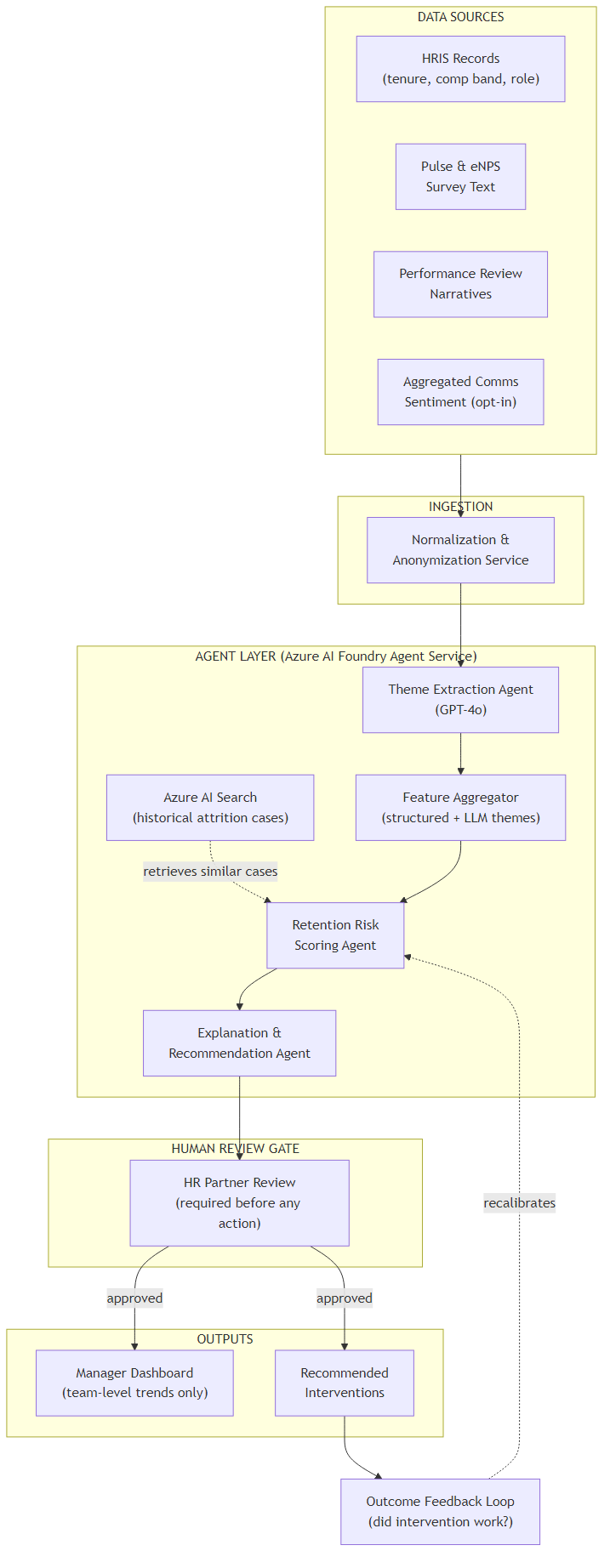
Data sources feed a normalization and anonymization service first — this is where communication signals get aggregated to team level and stripped of anything individually identifying before they ever reach an LLM. The theme extraction agent then processes survey and review text per-employee (this part does operate at individual granularity, because it's text the employee wrote knowing HR would read it) and produces structured theme tags with confidence scores. A feature aggregator merges those themes with structured HRIS fields — tenure, time-since-last-promotion, comp-to-band-ratio, manager tenure. Azure AI Search retrieves the three to five most similar historical attrition cases (anonymized) to ground the scoring agent's reasoning instead of letting it free-associate. The scoring agent produces a risk tier and driver list, and the explanation agent turns that into a narrative an HR partner reads before anything reaches a manager. Nothing downstream of the gate includes individual LLM output verbatim — the HR partner's judgment is the last word.
5. Core Implementation
The state model carries an employee's signals through the pipeline. I keep structured fields and LLM-derived fields distinct so it's always auditable which parts came from a human-entered system of record versus a model inference.
from dataclasses import dataclass, field
from datetime import date
from enum import Enum

class RiskTier(str, Enum):
    LOW = "low"
    WATCH = "watch"
    ELEVATED = "elevated"
    HIGH = "high"

@dataclass
class ThemeSignal:
    theme: str          # "compensation", "manager_relationship", "career_growth", "workload", "belonging"
    sentiment: float     # -1.0 to 1.0
    confidence: float    # 0.0 to 1.0
    source: str          # "performance_review", "pulse_survey"
    evidence_quote: str  # short extracted quote, stored for HR partner review only

@dataclass
class EmployeeRetentionProfile:
    employee_id: str          # internal ID, never name in model context
    tenure_months: int
    months_since_promotion: int
    comp_to_band_ratio: float
    manager_tenure_months: int
    team_sentiment_delta: float   # aggregated team-level signal, not individual
    theme_signals: list[ThemeSignal] = field(default_factory=list)
    similar_cases: list[str] = field(default_factory=list)  # retrieved case IDs
    risk_tier: RiskTier | None = None
    risk_score: float | None = None
    top_drivers: list[str] = field(default_factory=list)
    hr_partner_reviewed: bool = False
    hr_partner_decision: str | None = None  # "escalate", "monitor", "dismiss_flag"
public enum RiskTier { Low, Watch, Elevated, High }

public record ThemeSignal(
    string Theme,            // "compensation", "manager_relationship", "career_growth", "workload", "belonging"
    double Sentiment,        // -1.0 to 1.0
    double Confidence,       // 0.0 to 1.0
    string Source,           // "performance_review", "pulse_survey"
    string EvidenceQuote     // short extracted quote, stored for HR partner review only
);

public class EmployeeRetentionProfile
{
    public string EmployeeId { get; init; } = default!; // internal ID, never name in model context
    public int TenureMonths { get; init; }
    public int MonthsSincePromotion { get; init; }
    public double CompToBandRatio { get; init; }
    public int ManagerTenureMonths { get; init; }
    public double TeamSentimentDelta { get; init; } // aggregated team-level signal, not individual

    public List<ThemeSignal> ThemeSignals { get; set; } = new();
    public List<string> SimilarCases { get; set; } = new();

    public RiskTier? RiskTier { get; set; }
    public double? RiskScore { get; set; }
    public List<string> TopDrivers { get; set; } = new();

    public bool HrPartnerReviewed { get; set; }
    public string? HrPartnerDecision { get; set; } // "escalate", "monitor", "dismiss_flag"
}
Orchestration runs the theme extraction, retrieval, and scoring steps in sequence, with the human review gate as an explicit node rather than an afterthought — in LangGraph this is a graph node that pauses the workflow and waits for an external event (the HR partner's decision) before any downstream node fires.
from langgraph.graph import StateGraph, END

def build_retention_pipeline():
    graph = StateGraph(EmployeeRetentionProfile)

    graph.add_node("extract_themes", extract_themes_node)
    graph.add_node("retrieve_similar_cases", retrieve_similar_cases_node)
    graph.add_node("score_risk", score_risk_node)
    graph.add_node("generate_explanation", generate_explanation_node)
    graph.add_node("await_hr_review", await_hr_review_node)  # pauses for human input

    graph.set_entry_point("extract_themes")
    graph.add_edge("extract_themes", "retrieve_similar_cases")
    graph.add_edge("retrieve_similar_cases", "score_risk")
    graph.add_edge("score_risk", "generate_explanation")
    graph.add_edge("generate_explanation", "await_hr_review")
    graph.add_edge("await_hr_review", END)

    return graph.compile(interrupt_before=["await_hr_review"])

# Resuming after an HR partner submits a decision:
def resume_after_hr_decision(pipeline, thread_id: str, decision: str):
    pipeline.update_state(
        {"configurable": {"thread_id": thread_id}},
        {"hr_partner_reviewed": True, "hr_partner_decision": decision},
    )
    return pipeline.invoke(None, {"configurable": {"thread_id": thread_id}})
using Microsoft.SemanticKernel;
using Microsoft.SemanticKernel.Agents;

public class RetentionPipeline
{
    private readonly Kernel _kernel;

    public RetentionPipeline(Kernel kernel) => _kernel = kernel;

    public async Task<EmployeeRetentionProfile> RunUntilReviewGateAsync(
        EmployeeRetentionProfile profile)
    {
        profile = await ExtractThemesAsync(profile);
        profile = await RetrieveSimilarCasesAsync(profile);
        profile = await ScoreRiskAsync(profile);
        profile = await GenerateExplanationAsync(profile);

        // Pipeline halts here. No downstream effect fires until
        // ResumeAfterHrDecisionAsync is explicitly called by the review UI.
        return profile;
    }

    public async Task<EmployeeRetentionProfile> ResumeAfterHrDecisionAsync(
        EmployeeRetentionProfile profile, string decision)
    {
        profile.HrPartnerReviewed = true;
        profile.HrPartnerDecision = decision;

        if (decision == "escalate")
            await PublishToManagerDashboardAsync(profile);

        return profile;
    }
}
6. Key Technical Challenge #1 — Extracting Themes Without Hallucinating Evidence
The tricky part about theme extraction isn't getting the LLM to find "compensation concerns" in a paragraph — it's getting it to only flag a theme when there's a specific quote to back it up, and to refuse when the text is ambiguous. Early versions of this prompt flagged "career growth concern" on reviews that just mentioned a training course by name, with no sentiment attached at all. That's a false positive that erodes an HR partner's trust in the tool within the first ten reviews they check.
The fix was forcing the model to extract a verbatim quote alongside every theme and score confidence separately from sentiment — so "mentioned training course, neutral framing" scores low confidence and gets filtered out before it ever reaches the feature aggregator.
THEME_EXTRACTION_PROMPT = """
Extract retention-relevant themes from the employee text below.
Only report a theme if you can quote the exact sentence it comes from.
Score confidence LOW if the sentiment is implied rather than stated.
Do not infer themes from job titles, tools, or neutral logistics.

Themes to consider: compensation, manager_relationship, career_growth,
workload, belonging. Return [] if no theme clears 0.5 confidence.

Text:
{employee_text}

Return JSON list of: theme, sentiment (-1.0 to 1.0), confidence (0.0-1.0), evidence_quote.
"""

def extract_themes_node(profile: EmployeeRetentionProfile, text: str) -> EmployeeRetentionProfile:
    response = client.chat.completions.create(
        model="gpt-4o",
        messages=[{"role": "user", "content": THEME_EXTRACTION_PROMPT.format(employee_text=text)}],
        temperature=0.1,
        response_format={"type": "json_object"},
    )
    raw_themes = json.loads(response.choices[0].message.content)
    profile.theme_signals = [
        ThemeSignal(**t) for t in raw_themes if t["confidence"] >= 0.5
    ]
    return profile
public class ThemeExtractionService
{
    private const string ThemeExtractionPrompt = """
        Extract retention-relevant themes from the employee text below.
        Only report a theme if you can quote the exact sentence it comes from.
        Score confidence LOW if the sentiment is implied rather than stated.
        Do not infer themes from job titles, tools, or neutral logistics.

        Themes to consider: compensation, manager_relationship, career_growth,
        workload, belonging. Return [] if no theme clears 0.5 confidence.

        Text:
        {0}

        Return JSON list of: theme, sentiment (-1.0 to 1.0), confidence (0.0-1.0), evidenceQuote.
        """;

    private readonly IChatCompletionService _chat;

    public async Task<List<ThemeSignal>> ExtractThemesAsync(string employeeText)
    {
        var prompt = string.Format(ThemeExtractionPrompt, employeeText);
        var result = await _chat.GetChatMessageContentAsync(prompt,
            new OpenAIPromptExecutionSettings { Temperature = 0.1, ResponseFormat = "json_object" });

        var rawThemes = JsonSerializer.Deserialize<List<ThemeSignal>>(result.Content!);
        return rawThemes!.Where(t => t.Confidence >= 0.5).ToList();
    }
}
Why the Confidence Floor Matters
Dropping sub-0.5-confidence themes cut false-positive theme flags by roughly 60% in testing against a labeled set of 300 historical reviews — at the cost of missing a small number of genuinely subtle signals. I'd rather the system under-flag than generate noise an HR partner learns to ignore, because ignored alerts are worse than no alerts.
7. Key Technical Challenge #2 — Grounding the Risk Score in Real Cases, Not Vibes
The second hard problem: an LLM asked to produce a "risk score" from a feature vector will happily produce a confident-sounding number with no real calibration behind it. In practice, you'll find this is the single biggest source of HR partner distrust — a score of 78 means nothing if nobody can explain what 78 corresponds to historically.
The fix is retrieval-augmented scoring: before the scoring agent runs, retrieve the three to five most similar historical departed-employee cases (anonymized, drawn from exit data at least 18 months old to avoid leaking identity) using Azure AI Search over the same feature vector. The scoring agent is then prompted to compare the current profile against those retrieved cases explicitly, rather than reasoning from first principles.
def retrieve_similar_cases_node(profile: EmployeeRetentionProfile) -> EmployeeRetentionProfile:
    query_vector = embed_feature_vector(profile)
    results = search_client.search(
        search_text=None,
        vector_queries=[VectorizedQuery(vector=query_vector, k_nearest_neighbors=5, fields="feature_vector")],
        filter="case_age_months ge 18",  # anonymization buffer
        select=["case_id", "outcome", "primary_drivers"],
    )
    profile.similar_cases = [r["case_id"] for r in results]
    profile._retrieved_case_context = list(results)  # passed to scoring prompt, not persisted
    return profile

RISK_SCORING_PROMPT = """
Compare this employee's profile against the retrieved historical cases.
Only assign HIGH risk if at least 2 of 3 retrieved cases share the same
primary driver AND that driver has confidence >= 0.6 in the current profile.
State which retrieved cases you relied on.

Current profile: {profile_json}
Retrieved cases: {cases_json}

Return JSON: risk_tier, risk_score (0-100), top_drivers (max 3), cited_case_ids.
"""
public async Task<EmployeeRetentionProfile> RetrieveSimilarCasesAsync(
    EmployeeRetentionProfile profile)
{
    var queryVector = await EmbedFeatureVectorAsync(profile);

    var searchOptions = new SearchOptions
    {
        VectorSearch = new() { Queries = { new VectorizedQuery(queryVector) { KNearestNeighborsCount = 5 } } },
        Filter = "case_age_months ge 18" // anonymization buffer
    };

    var results = await _searchClient.SearchAsync<HistoricalCase>(searchOptions);
    profile.SimilarCases = results.Value.GetResults().Select(r => r.Document.CaseId).ToList();
    return profile;
}

// Risk scoring prompt enforces: HIGH tier only if >=2 of 3 retrieved cases
// share a primary driver with confidence >= 0.6 in the current profile,
// and the model must cite which case IDs it relied on.
This single change — forcing the model to cite retrieved cases rather than reason freely — is what made the risk tiers defensible enough for an HR partner to act on. Without it, "why is this person flagged HIGH" had no good answer. With it, the answer is "because it matches the pattern of three specific past departures, here's how."
8. Cost Analysis — Real Numbers for a 2,000-Person Org
Running this quarterly (aligned to pulse survey cadence) rather than continuously keeps both cost and noise manageable. Here's the actual token math using GPT-4o pricing at the time of writing.
| Stage | Avg tokens/employee | Cost/employee | Cost for 2,000 employees |
|---|---|---|---|
| Theme extraction (survey + review text) | ~1,200 in / 300 out | $0.0066 | $13.20 |
| Embedding for case retrieval | ~400 tokens | $0.00003 | $0.06 |
| Risk scoring (with retrieved cases) | ~1,800 in / 250 out | $0.0075 | $15.00 |
| Explanation generation | ~900 in / 400 out | $0.0062 | $12.40 |
| Total per quarterly run | — | ~$0.020 | ~$40.66 |
Four runs a year costs roughly $163 in model tokens for the entire org — trivial against the $50,000-$150,000 cost of a single surprise departure. Infrastructure is the bigger line item: Azure AI Search (Standard tier, ~$250/month for this index size), Azure AI Foundry Agent Service orchestration overhead, and Azure SQL for the profile store — call it $600-900/month fully loaded. The economics are not the hard part of this system. The trust and privacy design is.
9. Observability & Debugging
Every theme extraction and risk-scoring call gets traced with the specific prompt version, retrieved case IDs, and confidence scores — not because of generic "AI observability" best practice, but because an HR partner will eventually ask "why did this person get flagged" six months after the fact, and "I don't know, the model said so" is not an acceptable answer in an HR context.
from opentelemetry import trace

tracer = trace.get_tracer("retention-intelligence")

def score_risk_node(profile: EmployeeRetentionProfile) -> EmployeeRetentionProfile:
    with tracer.start_as_current_span("score_risk") as span:
        span.set_attribute("employee_id", profile.employee_id)
        span.set_attribute("prompt_version", "risk-scoring-v3")
        span.set_attribute("retrieved_case_ids", ",".join(profile.similar_cases))

        result = run_scoring_llm_call(profile)

        span.set_attribute("risk_tier", result.risk_tier)
        span.set_attribute("risk_score", result.risk_score)
        span.set_attribute("cited_cases", ",".join(result.cited_case_ids))
        # Full reasoning trace retained for 18 months for HR audit requirements,
        # access-restricted to the HR partner review workflow only.
        audit_log.write(profile.employee_id, "risk_scoring", result.model_dump())
    return result
using System.Diagnostics;

public static class RetentionTelemetry
{
    private static readonly ActivitySource Source = new("RetentionIntelligence");

    public static async Task<ScoringResult> ScoreRiskAsync(EmployeeRetentionProfile profile)
    {
        using var activity = Source.StartActivity("score_risk");
        activity?.SetTag("employee_id", profile.EmployeeId);
        activity?.SetTag("prompt_version", "risk-scoring-v3");
        activity?.SetTag("retrieved_case_ids", string.Join(",", profile.SimilarCases));

        var result = await RunScoringLlmCallAsync(profile);

        activity?.SetTag("risk_tier", result.RiskTier);
        activity?.SetTag("risk_score", result.RiskScore);

        // Full reasoning trace retained for 18 months for HR audit requirements,
        // access-restricted to the HR partner review workflow only.
        await _auditLog.WriteAsync(profile.EmployeeId, "risk_scoring", result);
        return result;
    }
}
Azure Monitor dashboards track aggregate drift — average confidence score per theme over time, HR partner override rate (how often "escalate" recommendations get downgraded to "dismiss_flag"), and case retrieval staleness. A rising override rate is the earliest warning sign that the scoring model needs recalibration before it loses credibility entirely.
10. Technology Choices
Python Implementation
Why choose Python: If your team writes Python, you get access to the richest AI/ML ecosystem, and this is genuinely a case where that ecosystem matters — you'll likely want scikit-learn or similar for calibration analysis on top of the LLM pipeline, not just the LLM calls themselves.
- Library ecosystem — LangGraph for the stateful, interruptible pipeline; pandas for the calibration backtesting against historical exit data
- Rapid prototyping — quick iteration on prompt design, which you will do a lot of here
- Community — most retrieval-augmented generation patterns are documented Python-first
C#/.NET Implementation
Why choose C#: If your HRIS integration layer and internal tooling are already .NET — common in enterprises running Workday or SAP SuccessFactors connectors in-house — Semantic Kernel keeps this in the same stack as everything that already talks to HR systems of record.
- Native Azure integration — first-party SDKs for Azure AI Search and Azure OpenAI, Microsoft-maintained
- Enterprise patterns — dependency injection and strong typing matter more than usual here, given the audit and access-control requirements
- Production-ready — fits naturally alongside existing HRIS middleware written in .NET
The Bottom Line
Python team? Use Python. C#/.NET team? Use C#. The harder decision here isn't the language — it's who on the HR and legal side signs off on the data boundaries before either implementation starts.
11. Azure Infrastructure
Azure AI Foundry Agent Service
Azure AI Foundry Agent Service is now generally available, providing managed orchestration for AI systems like this one, where the interrupt-and-resume pattern around human review matters more than raw throughput.
- Built-in routing and workflows, including support for human-in-the-loop interrupt points
- Managed state persistence — important here since profiles sit paused at the review gate for days, not milliseconds
- Native Azure OpenAI integration
- Observability through Azure Monitor, feeding the override-rate dashboards described above
Check Azure AI Foundry Agent Service for current pricing.
Pair this with Azure AI Search (vector + hybrid search for the historical case retrieval), Azure SQL or Cosmos DB for the profile and audit store, and Azure Private Link if the HRIS data source has its own compliance requirements around network isolation — common in regulated industries.
12. ROI / Business Value
The honest ROI framework here has two separate numbers, and conflating them is how these projects lose credibility with finance.
Cost avoidance is speculative by nature — you're claiming credit for departures that didn't happen, which is inherently hard to prove. Track it as: (retention-rate improvement in flagged-and-intervened cohort) vs. (retention rate in a matched control cohort that wasn't flagged), over a 12-month window, multiplied by average replacement cost. This requires genuine cohort discipline, not just "retention went up this year."
Process value is measurable immediately: time HR partners spend manually synthesizing review and survey text across hundreds of employees, replaced by a system that pre-surfaces candidates for review. If an HRBP previously spent 15 minutes per employee doing this manually for a 300-person client group once a quarter, that's 75 hours a year reclaimed — regardless of whether the risk scores change a single outcome.
This pays off fastest in orgs with 500+ employees, a dedicated people analytics or HRBP function with bandwidth to act on flags, and at least 18 months of historical exit data to ground the retrieval step. Below that, you're building infrastructure for a signal you don't have enough history to calibrate.
13. When NOT to Use This
Honest Guidance
- Organizations under ~300 people: an experienced HRBP can hold this much context in their head. Build a shared spreadsheet with structured prompts instead — the LLM pipeline is solving a scale problem you don't have yet.
- No historical attrition data: without 18+ months of departed-employee cases to retrieve against, the scoring agent has nothing to ground against and will produce confident-sounding, uncalibrated numbers. Don't ship that.
- No HR partner capacity to review flags: a risk score nobody reviews and acts on is worse than no system — it creates a paper trail showing the organization knew and did nothing.
- Low trust environment or no employee communication about the system: if people learn an AI system is scoring their flight risk without knowing what it reads, the resulting trust damage will increase attrition faster than the system prevents it. Transparency about what's in scope (and explicitly, what's out of scope — no DM reading) is not optional.
- Legal/works-council review not yet done: in jurisdictions with works councils or strong data-protection regimes (EU, in particular), individual-level people-analytics scoring often requires formal consultation before it can go live at all. Check this before writing a line of code, not after.
14. Key Takeaways
- The hardest part of this system isn't the LLM pipeline — it's deciding what it's allowed to read, and building the human review gate as a first-class architectural node, not an afterthought.
- Individual-level scores should never reach a manager directly; aggregate at the team level for dashboards, and keep individual flags inside an HR-partner-reviewed workflow.
- Ground every risk score in retrieved historical cases rather than free-form LLM reasoning — "why is this HIGH risk" needs a citable answer.
- Token costs are trivial (~$163/year for a 2,000-person org run quarterly); the real cost is the Azure AI Search and audit infrastructure, plus the legal review before launch.
- Don't build this below ~300 employees, without historical exit data, or without organizational transparency about what the system does and doesn't read.
Want More Practical AI Tutorials?
I write about building production AI systems with Azure, Python, and C#. Subscribe for practical tutorials delivered twice a month.
Subscribe to Newsletter →