What This Article Covers
- Why patient records, clinical notes, and unpublished research carry a different order of AI risk than ordinary hospital or institute paperwork
- What day-to-day clinical and research work looks like before and after moving onto an isolated AI setup
- How to calculate the financial case for private AI deployment against your own data exposure risk
- What isolated AI actually costs to build and run, with running-cost and one-time project tables
- The honest checklist: when this is worth building, and when you should walk away from the idea entirely
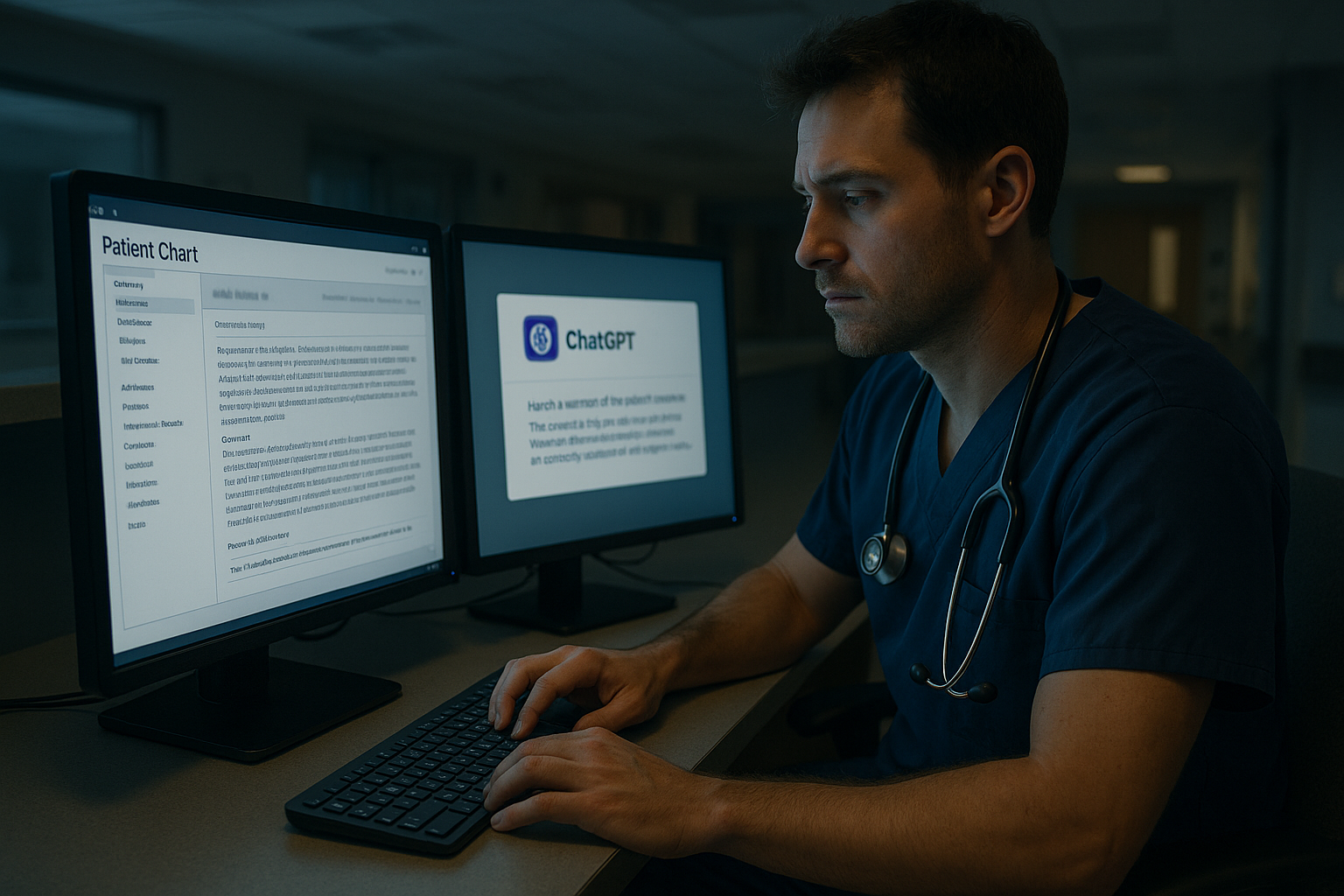
A senior registrar at a mid-sized public hospital is finishing a discharge summary for a complex patient with multiple comorbidities. It's the end of a long shift, and the patient's history — medication list, recent pathology results, imaging findings, and a chronic condition history spanning a decade — is dense enough that drafting the summary from scratch will take another forty minutes. The registrar pastes the patient's full case notes into a public AI assistant and asks it to draft a structured discharge summary. The result is clean, clinically coherent, and ready in under a minute after a light edit. It goes into the patient's file.
Eleven months later, the hospital's privacy office is notified of a potential data handling breach as part of an unrelated audit of AI tool usage across clinical departments. The investigation finds that this was not an isolated case — dozens of clinicians across the hospital have been pasting patient names, Medicare numbers, and detailed clinical histories into consumer AI tools for months, with no record of what was submitted, where it went, or whether it was retained. What began as a routine documentation shortcut becomes a mandatory notifiable data breach report to the Office of the Australian Information Commissioner, a review of every affected patient file, and a finding that the hospital cannot demonstrate where a substantial volume of identifiable patient data has ended up.
I'll address this upfront: I'm not saying public AI tools have no place in a hospital or research institute. For drafting a general patient education handout, summarising a publicly available clinical guideline, or preparing internal training material, they're fine. The problem is specific, and it applies every week to clinicians drafting letters from patient charts, and to researchers drafting grant applications and manuscripts from unpublished trial data — usually without anyone having deliberately decided the organisation would carry that risk.
1. Is This Right for Your Operation?
Before I explain how the exposure works, here is the honest filter. Not every hospital, health service, or research institute needs an isolated AI deployment on day one. Some do, urgently. Here's how to tell which side you're on.
Isolated AI Works Well If…
- Your clinicians or researchers regularly use AI tools to draft letters, summarise charts, or analyse patient records, pathology results, imaging reports, or unpublished trial data
- Your organisation is subject to regulatory obligations governing health information — the Privacy Act 1988, the Australian Privacy Principles, state health records legislation, or a Human Research Ethics Committee (HREC) approval that restricts how identifiable data can be processed
- Your research pipeline includes unpublished findings, trial protocols, or genomic data that would lose commercial or academic value if it appeared in a competitor's or another institute's hands before publication
- Your cyber insurance renewal questionnaire now asks specific questions about how AI tools handle patient or research data, and you don't have confident answers
- A single data exposure incident, whether clinical or research-related, would trigger a mandatory notifiable data breach report or damage patient trust in a way that's hard to repair
Walk Away If…
- Your staff only use AI for general patient education content, publicly available clinical guidelines, or content that carries no patient or research confidentiality obligation — public AI is fine for this
- You don't have the budget or internal capability to maintain an isolated model server over a 2–3 year horizon — a poorly maintained private deployment creates more exposure than a well-managed public one
- Your organisation doesn't have anyone who can own infrastructure patching, model updates, and access control; isolated AI is not a "set and forget" purchase
- You're looking for a way to use AI on patient or research data without spending anything — isolated AI has real costs, and cutting corners on them defeats the point
2. What Changes Day-to-Day
Here's what I've seen derail otherwise sound projects: the assumption that isolated AI means slower, clunkier tools than what clinical and research staff already use. It doesn't. The shift is architectural, not experiential. Your clinicians and researchers use the same interfaces and the same query patterns. What changes is entirely where the data goes once they hit enter.
Before: Fast Documentation With Hidden Exposure
A Wednesday afternoon at a regional health service. A clinical researcher preparing a grant renewal application pastes the unpublished interim results of a Phase II trial — response rates, adverse event data, and a draft of the statistical methods section — into a public AI assistant to get help tightening the narrative. The draft comes back well-structured in under a minute. The researcher is pleased with the time saved. Nobody notices that the trial's interim results, which are embargoed under the study's publication agreement, have just been processed on servers owned by an overseas technology company, under terms of service that permit submitted content to be used to improve the underlying model. There is no record in the institute's systems of what was submitted or when. If a competing research group publishes a strikingly similar finding before the trial's own paper is out, there is no way to rule out where the idea came from.
After: Same Speed, Nothing Leaves the Organisation
The same Wednesday afternoon, six months after an isolated deployment. The researcher pastes the same categories of information into the same-looking chat interface. The draft comes back in a comparable time. The documents were processed on a server the institute leases exclusively, sitting inside its own network. Nothing left the perimeter. The query is logged against the researcher's user account and the trial's ethics approval reference. If the sponsor or the HREC ever asks who has seen the interim data, the answer is a complete audit log, not a shrug.
"The shift in mindset is from asking ‘is this AI tool on our approved list’ to asking ‘where does this patient's or this trial's data go, and who can see it, once I press enter.’"
3. The Business Case
The number that surprises most people is not the cost of building an isolated AI deployment — it's the cost of the incident it replaces. Across the patient and research data exposure incidents I've reviewed at health services and research institutes, the average all-in cost — regulatory notification, patient or participant support, remediation, legal costs, and the clinical governance and privacy team hours spent managing the fallout — lands around $420,000 per incident. That figure sits well below headline mega-breach numbers you may have seen elsewhere, because it reflects the more common scenario at a hospital, health service, or institute of a few hundred to a few thousand staff: one patient file or one trial dataset, one bad outcome, one very expensive investigation.
The business case for isolated AI doesn't require your organisation to have already had an incident. It requires an honest estimate of three things: how often your clinicians or researchers are putting patient or research data into public AI tools, what a data exposure incident involving that data would cost you, and what an isolated deployment costs to build and run. In the engagements I've worked through, isolated AI pays back within 8–14 months on data exposure risk reduction alone — before counting the productivity gain from finally being able to use AI on clinical and research work that was previously too sensitive to touch.
ROI Calculator — Data Exposure Risk vs. Isolated AI
Adjust the sliders to match your organisation. Results update in real time.
Calculator assumes a 75% reduction in data exposure incident probability with isolated AI deployment. Project cost is estimated at $220,000 base plus $150 per 100 monthly queries. Annual infrastructure is $42,000. Regulatory fines and reputational impact on patient recruitment or philanthropic funding are not included — add those separately.
Patient and Research Data Exposure Incidents Per Quarter — Before and After Isolated AI
Q1–Q4 2025 shows baseline exposure incidents using public AI tools across a mid-sized health service and its affiliated research institute. Q1 2026 shows a transition quarter spike as a shadow AI audit surfaces existing unsanctioned use before the private deployment goes live. Q2–Q4 2026 shows the reduction after full isolated deployment.
4. How the System Works
Be sceptical of any vendor quoting an isolated AI deployment as a simple software swap. What you are actually building is a complete data processing environment that sits inside your organisation's own network perimeter, connected to the systems your clinicians and researchers already use — the electronic medical record (EMR), the research laboratory information management system (LIMS), and imaging systems (PACS). Here's what that looks like in six stages.
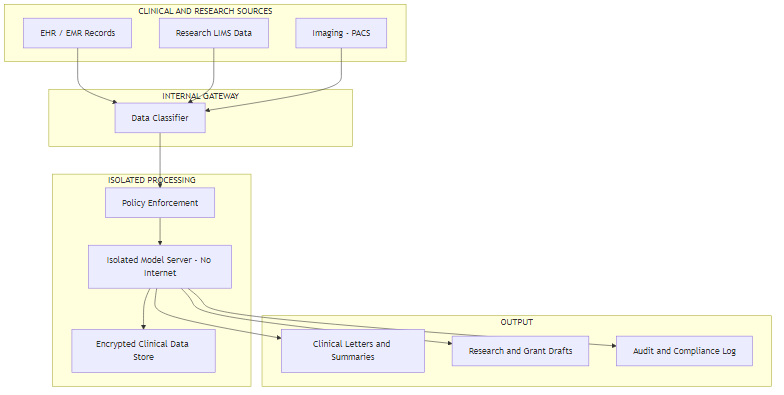
Stage 1 — Data Enters the Internal Gateway. Patient records, clinical notes, imaging reports, and research datasets originate from your existing systems — the EMR, the LIMS, PACS, or a trial management platform. A data classifier checks the content against your organisation's governance policy before the AI ever sees it. Queries that don't meet policy are returned to the user with a clear explanation, not silently blocked.
Stage 2 — Policy Enforcement. Your organisation sets the rules: which data types can go to which AI functions, who is authorised to submit what, and what must be logged. For clinical departments this includes patient-identifiable flags; for a research institute, embargoed trial data and unpublished manuscript flags. The policy enforcer applies these rules at the gateway — not buried inside the AI model where your privacy team can't see them.
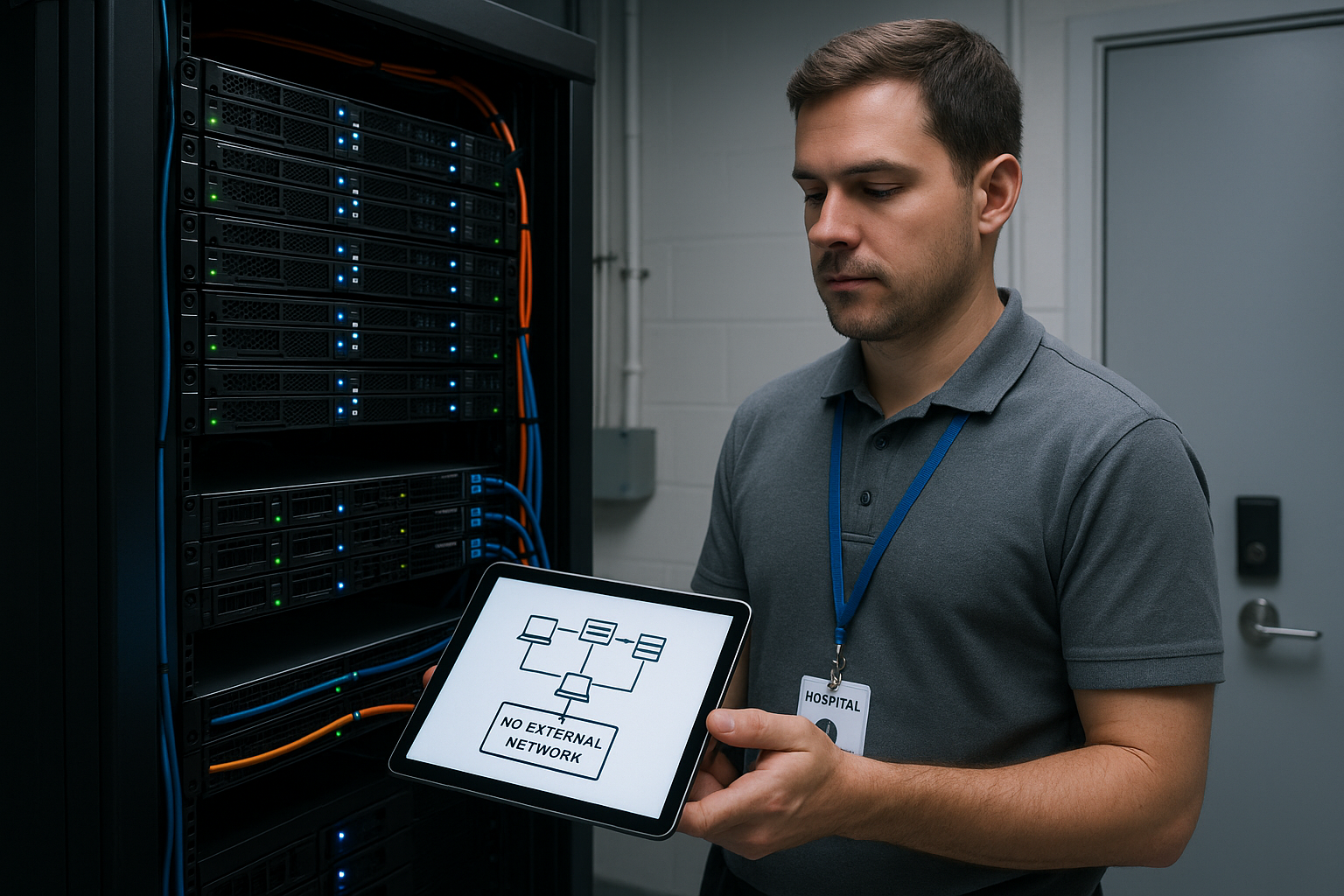
Stage 3 — Isolated Model Processing. The approved query reaches the local language model server. This server has no outbound internet connectivity. It cannot call external APIs, phone home to a vendor's telemetry endpoint, or send query content anywhere outside your infrastructure. The model runs on hardware your organisation owns or leases exclusively.
Stage 4 — Encrypted Clinical and Research Data Store. Any data retained for context, patient history, or audit purposes sits in an encrypted store inside your perimeter. Your organisation holds the encryption keys, not a third-party AI vendor.
Stage 5 — Output Generation. The discharge summary, referral letter, literature review draft, or grant application section is generated and returned through the same internal channel. It never travels over the public internet.
Stage 6 — Audit Trail. Every query is logged against the user, the patient's medical record number or the study's ethics approval reference, the timestamp, and the data classification. If the OAIC, an HREC, or a trial sponsor asks what happened to a piece of data, you can answer with a complete record instead of an educated guess.
5. How the AI Data Risk Actually Works
Most clinical directors and research leads I speak with assume data submitted to a public AI tool is handled roughly the way a search query is handled — processed briefly, then discarded. The reality is more complicated, and the distinction matters enormously for organisations holding identifiable patient records or embargoed research findings.
The Key Distinction: Controlled Custody vs. Commingled Processing
Think about how your organisation already handles a pathology specimen — every step from collection to result has a documented chain of custody, and the specimen never sits alongside an unrelated patient's sample without a clear, logged reason. Data submitted to a public AI tool works the opposite way. Three things happen that wouldn't happen in a properly controlled system:
- The content is sent to external servers, typically in a foreign jurisdiction, outside the regulatory perimeter your Privacy Act and Australian Privacy Principles obligations assume you control — a cross-border disclosure that APP 8 specifically requires you to account for.
- The content may be used to improve the model under terms of service that most clinicians and researchers have never read. Opt-out options exist for some platforms, but they're not universal, not always retroactive, and not always verifiable from your side.
- The content is processed alongside queries from every other user on shared, multi-tenant infrastructure. Vendors take steps to isolate sessions, but the underlying architecture commingles your patient's or your trial's data with everyone else's on the same platform — the digital equivalent of running every specimen through a shared, unlabelled batch with hundreds of unrelated samples.
There's a second layer specific to health data that doesn't come up in most other industries: re-identification risk. A clinician might reasonably believe a summary is "de-identified" once the patient's name is removed, but a rare diagnosis, an unusual combination of dates, and a specific regional health service context can be enough to re-identify a patient when combined — and every additional detail pasted into a public AI query widens that surface area. An isolated AI deployment restores the controlled custody your patients and research participants already expect from you in every other part of their care or trial participation. Their data doesn't leave your servers. It isn't used to train someone else's model. It's processed on hardware you control, and the query log belongs to your organisation. Output quality is comparable to the public alternative — open-weight models in the 7B–70B parameter range (the number refers to how many internal settings the model has learned, a rough proxy for capability) now perform well enough for clinical drafting, literature summarisation, and first-pass research analysis without needing a public internet connection.
6. What It Costs
I'll be direct about costs, because this is where proposals I've reviewed for health services and research institutes have most often been either too optimistic or deliberately vague. There are two categories: the one-time project cost to build the deployment, and the ongoing annual cost to run it.
| Running Cost Item | Typical Annual Cost | Notes |
|---|---|---|
| Dedicated inference server (leased) | $24,000–$48,000 | Depends on model size and concurrent clinician/researcher load |
| Infrastructure management | $18,000–$32,000 | Patching, monitoring, access control updates |
| Model licensing (open-weight) | $0–$14,000 | Open-weight models are often free for enterprise use; some require commercial licences |
| Clinical data security and compliance audit (annual) | $14,000–$24,000 | Privacy impact assessment refresh, penetration testing, access log review |
| Staff training and governance | $8,000–$14,000 | Annual refresher and policy update cycle for clinical and research staff |
| One-Time Project Cost Item | Typical Cost | Notes |
|---|---|---|
| Infrastructure setup and configuration | $36,000–$56,000 | Server provisioning, network isolation, firewall rules |
| Model selection and clinical fine-tuning | $22,000–$45,000 | Selecting the right model for clinical and research terminology; domain-specific tuning if required |
| EMR / LIMS / PACS integration | $34,000–$58,000 | Connecting the AI layer to your existing electronic medical record, research, and imaging systems |
| Data governance and privacy framework | $20,000–$34,000 | Privacy impact assessment, de-identification protocol, ethics committee documentation, audit trail setup |
| Pilot and validation | $12,000–$20,000 | Controlled testing before full deployment |
The Number That Surprises Most People
The most common budget error in these projects is underestimating the cost of integrating with the EMR, LIMS, or PACS system and getting the de-identification protocol right. The AI server itself is not the hard part — getting the isolated system to correctly recognise a patient's medical record number, a rare diagnosis that could re-identify someone, or an embargoed trial reference is where projects run over budget. Build $34,000–$58,000 into your project budget for this integration work before you sign anything. If a vendor's quote seems light here, ask exactly how the system will distinguish a patient's identifiable chart from a de-identified research dataset.
Where Your Clinical Governance & Risk Budget Currently Goes
The red slice — reactive incident remediation — is the target. Isolated AI shifts spend from reactive damage control to planned, auditable infrastructure.
7. What Your Team Needs
Here's what I've seen derail otherwise sound projects: launching an isolated AI deployment without the internal capability to run it. This is not a vendor-managed subscription you can forget about after go-live. It requires real ownership inside the organisation.
The minimum viable internal team is:
- One infrastructure owner — responsible for server health, the patching schedule, and access control. Does not need to be a data scientist. A senior clinical systems engineer with Linux server experience can fill this role.
- One data governance owner — responsible for the classification policy, de-identification rules, and the quarterly audit of query logs. This is typically your privacy officer, Health Information Manager, or research governance lead, with 2–4 hours per month of dedicated time.
- One technical integration lead (for the build phase only) — connects the AI layer to your EMR, LIMS, or PACS system. This can be an external contractor for the first 3–6 months, with handover to your internal infrastructure owner once the system is stable.
On build vs. buy: the honest answer is that most health services and research institutes are better served by a specialist implementation partner than by building everything in-house. The reason is integration work — connecting an isolated model cleanly to an EMR or LIMS platform, and getting the classification and de-identification rules right, requires specialised knowledge that's hard to develop internally for a one-time build. Once the system is live, ongoing operations and maintenance can almost always sit with your existing clinical IT team.
| Phase | Duration | Key Activities | Who Leads |
|---|---|---|---|
| 1. Data governance and shadow AI audit | Weeks 1–3 | Map which patient and research data types your clinicians and researchers currently submit to public AI tools. Classify by sensitivity and regulatory exposure. | Internal privacy or research governance officer |
| 2. Use case prioritisation | Weeks 4–5 | Identify the 3–5 highest-value use cases currently blocked by confidentiality concerns — discharge summary drafting, differential diagnosis literature search, trial protocol summarisation, grant application drafting. | Clinical/research leads + IT |
| 3. Infrastructure build | Weeks 6–13 | Server provisioning, network isolation, model deployment, integration with EMR, LIMS, or PACS system. | External implementation partner |
| 4. Pilot and validation | Weeks 14–17 | Controlled rollout to one department or research group. Test output quality, logging, de-identification, and policy enforcement against real records. | Internal IT + pilot team |
| 5. Full deployment and handover | Weeks 18–21 | Organisation-wide rollout. Staff training. Handover of infrastructure ownership to internal team. First governance review scheduled. | Internal IT (primary) |
| 6. Ongoing operations | Ongoing | Monthly patching cycle, quarterly de-identification and audit log review, annual model update assessment, annual security audit. | Internal infrastructure owner |

8. How You Know It's Working
The metrics for an isolated AI deployment at a health service or research institute are different from the metrics you'd track for a standard IT rollout. You're not just measuring uptime — you're measuring whether the deployment is actually reducing patient and research data exposure and delivering the productivity outcomes that justified the spend.
| Metric | What It Measures | 12-Month Target |
|---|---|---|
| % of patient/research AI queries routed through isolated system | Whether clinical and research staff have actually moved from public tools to the private deployment | 95% of patient/research queries through isolated system |
| Policy exception rate (queries blocked at gateway) | Whether the classification policy is calibrated correctly — too high means overly restrictive; too low means identifiable or embargoed data is slipping through | Under 3% exception rate; exceptions reviewed weekly |
| Audit log completeness | Whether every query is captured with the metadata needed for the OAIC, an HREC, or a trial sponsor to review | 100% query logging; monthly audit report generated |
| Patch currency (days since last security patch) | Whether the infrastructure is being actively maintained, not just monitored | Zero critical patches outstanding; patches applied within 14 days of release |
| Staff-reported productivity change | Whether the isolated system is delivering comparable productivity to public tools, or creating friction that drives staff back to shadow AI use | Neutral or positive in 80% of quarterly staff survey responses |
9. Where to Start
In practice, the right starting point for most organisations is not a full deployment. It's an honest audit of what's already happening. Here are five specific actions, in order.
- Conduct a shadow AI audit in the next 30 days. Ask each clinical department and research group to list every AI tool currently in use, including free consumer tools staff have signed up for individually. Don't assume the answer is "just the approved ones." In my experience, most health services and research institutes discover 4–8 unsanctioned AI tools in active use once someone asks the question directly. Map what patient or research data is being submitted to each.
- Classify your data by sensitivity tier. Not all clinical and research data carries the same risk. A three-tier classification — public, internal, patient-identifiable or embargoed — is usually sufficient for a first deployment. Patient-identifiable and embargoed research data (unpublished trial results, genomic data, identifiable clinical notes) goes into the isolated system. Internal data can often stay on managed public AI with appropriate access controls. Public data needs no restriction.
- Identify your three highest-value blocked use cases. Where are your clinicians or researchers currently avoiding AI because the data is too sensitive? Discharge summary drafting, differential diagnosis literature review, trial protocol summarisation, grant application drafting — these are the use cases that justify the investment. Quantify the time cost of doing them manually at current staff rates. That's your productivity ROI figure.
- Brief two or three specialist implementation partners. Not general IT vendors — firms with specific experience deploying private language models in healthcare or research settings. Ask for a fixed-price proposal for a 4-week proof of concept on your top use case. The proof of concept will tell you more than any vendor presentation.
- Put the governance framework in place before the first query goes through the system. The classification policy, de-identification rules, and audit log format should be designed and signed off — including HREC input where research data is involved — before the isolated model touches production data. Retrofitting governance onto a live deployment is significantly harder and more expensive than building it in from the start.
Key Takeaways
Five Decisions This Article Should Help You Make
- Is the exposure real for your organisation? Use the shadow AI audit in Step 1. If your clinicians or researchers are submitting patient records, clinical notes, or unpublished research to public tools — and in most health services and institutes, they are — the exposure is already active.
- Is the business case there? Use the ROI calculator above with your own incident cost estimates. If the payback is under 14 months on data exposure risk reduction alone, the numbers support the project.
- Do you have the internal capability? You need one infrastructure owner and one data governance owner at minimum. If those roles don't exist yet, build that into the project scope before you start.
- Should you build or buy? For most hospitals, health services, and research institutes, a specialist implementation partner for the build phase — with handover to internal IT for operations — is almost always the right model. Full in-house builds suit organisations with larger, more mature IT and security functions already in place.
- What does good look like? By month 12, 95% of patient and research AI queries should route through the isolated system, audit logs should be complete, and your privacy and governance team should be able to answer any regulator's or ethics committee's question about data handling in under an hour.
Want Practical Insights on AI in Operations?
I write about applying AI to real business problems — with honest numbers and no vendor speak. Subscribe for articles delivered twice a month.
Subscribe to Newsletter →