A mid-sized SOC I looked at recently was processing around 4,000 alerts a day across three tools, with two analysts on shift. That's roughly one alert every 45 seconds if nobody sleeps, eats, or investigates anything properly. I built this copilot because triage — not remediation — is where most incident response programs actually drown.
What You'll Learn
- Why alert-volume math breaks traditional SOC staffing models, and where AI actually helps versus where it doesn't
- How to architect a triage-and-response pipeline with enrichment, RAG-based playbook retrieval, and a confidence-gated action planner
- Full implementation in Python (LangGraph) and C# (Semantic Kernel), including the guardrails around tool-calling for remediation actions
- Real token and infrastructure cost numbers for running this at 4,000+ alerts/day
- When this approach is overkill — and what to build instead if you're a five-person security team
The Alert Volume Problem
Every SOC I've looked into has the same shape of problem: alert volume grows faster than headcount, and headcount growth is capped by budget and by how few qualified analysts exist to hire in the first place. The result is alert fatigue — analysts skimming dashboards, closing things as "false positive" without real investigation, and missing the one alert in three thousand that actually mattered.
The instinct is to buy more SIEM correlation rules or a fancier XDR platform. That helps at the margins, but it doesn't fix the core issue: someone still has to read each alert, pull context from four different systems, decide what it means, and decide what to do about it. That's a reasoning task, not a rules-matching task, and rules engines are bad at reasoning.
I built this because I wanted to see how far an LLM-based triage layer could go — not replacing analysts, but absorbing the repetitive 80% of alerts (the reconnaissance scan that got blocked by the firewall anyway, the phishing email that never got clicked, the failed login from a geography the user visits every quarter) so analysts spend their time on the alerts that actually need a human brain.
Who has this problem? Almost anyone running a SOC past a certain size, but it's sharpest in mid-market companies — big enough to have real attack surface and a compliance mandate for 24/7 monitoring, not big enough to staff a 20-person SOC with dedicated Tier 1, Tier 2, and threat-hunting rotations. That's the gap where a triage copilot earns its keep: not replacing a mature SOC's tooling, but giving a lean team the coverage a much bigger team would otherwise provide.
Existing tooling fails here for a structural reason, not a quality reason. SIEM correlation rules and SOAR playbooks are both built on if-this-then-that logic, and alert triage genuinely isn't an if-this-then-that problem — it's a "weigh five pieces of loosely related context and form a judgment" problem, which is exactly the kind of task LLMs are comparatively good at and rules engines are structurally bad at.
Current Approach and Its Limits
Most SOCs today lean on one of two things: static correlation rules in the SIEM, or a SOAR (Security Orchestration, Automation and Response) platform with hand-built playbooks. Both work, but both have a ceiling.
Correlation rules are precise but brittle — they catch exactly the pattern you wrote them for and nothing adjacent. A rule that fires on "5 failed logins in 2 minutes" says nothing about whether the account belongs to a finance controller or a service account that always looks like that. SOAR playbooks are more flexible but still deterministic: they're a flowchart, and flowcharts don't handle the alert that's 80% like case type A and 20% like case type B.
There's a second, quieter cost: rule sprawl. Every SOC I've looked at has a correlation rule library that's grown for years without much pruning, because nobody wants to be the analyst who deleted the rule that would have caught next month's incident. That sprawl means more noise, not less, and tuning it down takes exactly the kind of sustained analyst attention that alert fatigue makes hard to sustain.
The cost of this shows up as analyst time, not license fees. In the SOC I mentioned, average time-to-triage for a single alert — just deciding "is this real and how bad is it," not resolving it — ran close to 12 minutes when done properly. At 4,000 alerts a day, that's not a staffing problem you solve by hiring; it's a math problem. Even doubling headcount only buys you a factor of two, and alert volume in most environments grows faster than that year over year as logging coverage expands.
The Solution Approach
The core idea is a pipeline that mirrors what a good Tier 1/2 analyst actually does: normalize the alert, pull enrichment context, classify severity and category, retrieve the relevant incident response playbook, reason about what action the playbook calls for, and then make a calibrated decision — auto-remediate if it's low-risk and high-confidence, escalate with full context if it isn't.
The benefits over rules-only triage are threefold. First, the LLM can weigh context a rules engine can't ("this failed-login pattern is unusual for this specific user, even though it wouldn't trip a generic threshold"). Second, RAG-based playbook retrieval means adding a new incident type is a documentation change, not a code change — you write the runbook, the system starts using it. Third, every decision — auto or escalated — gets a structured audit trail, which most rules engines never produce in a form anyone actually reads later.
None of this replaces the SIEM or the EDR — it sits downstream of them, consuming what they already generate. That's a deliberate scoping choice. I've seen "AI SOC" pitches that try to replace detection logic itself with an LLM, and in practice that's a worse trade: detection benefits from deterministic, auditable rules that catch known-bad patterns reliably and cheaply. The reasoning-heavy work — deciding what a detection actually means once you've caught it, and what to do about it — is where an LLM adds value that rules can't. Keep the boundary there and each layer does the job it's actually good at.
Tech stack: Azure OpenAI (GPT-4o-mini for the high-volume classification step, GPT-4o for the reasoning-heavy action-planning step), Azure AI Search for playbook retrieval, Cosmos DB for state and the audit trail, and either LangGraph (Python) or Semantic Kernel (C#) for orchestration depending on your team's stack.
The trade-off worth naming up front: this system is only as good as the playbook library and the guardrail policy behind it. It doesn't invent incident response procedure — it retrieves and applies procedure that a human already wrote down. If your organization's IR knowledge lives entirely in a few senior analysts' heads rather than in documented runbooks, the first project isn't this pipeline, it's writing those runbooks. That's true whether or not you ever build the AI layer on top of them.
Architecture Overview
The pipeline has six stages: ingestion and normalization, enrichment, triage classification, playbook retrieval, action planning, and the confidence gate that routes to either auto-remediation or human escalation. Every stage writes to the audit trail, not just the final decision.
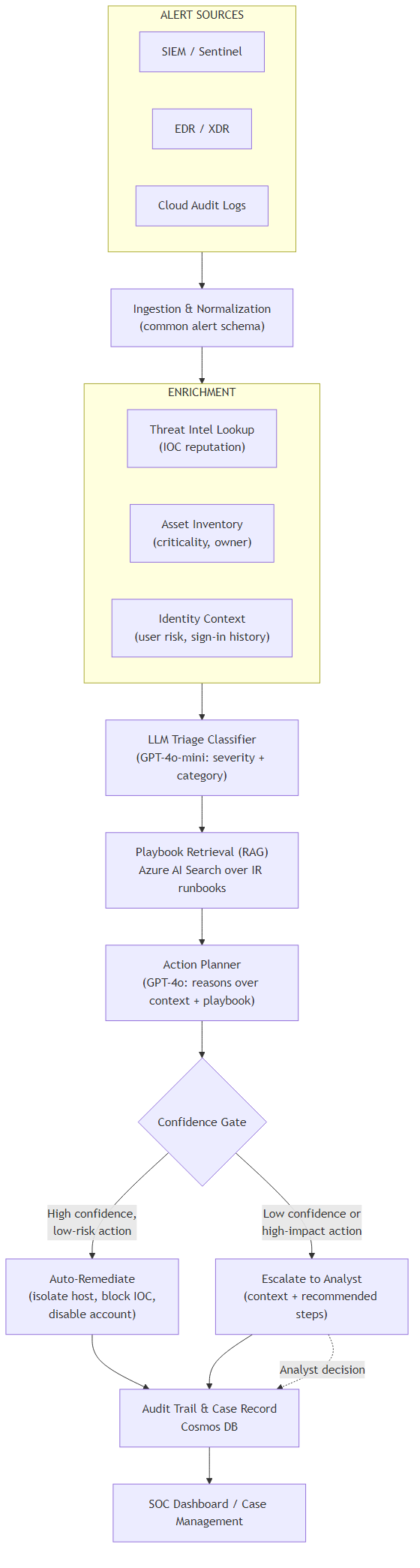
Alerts arrive from SIEM (Sentinel), EDR/XDR, and cloud audit logs, each with a different schema. Normalization maps them to a common alert model before anything else touches them. Enrichment then pulls three things in parallel: threat intel reputation for any IOCs (IPs, hashes, domains), asset criticality and ownership from the CMDB, and identity risk context for any user involved (recent sign-in history, existing risk score).
The triage classifier — a cheaper, faster model — takes the enriched alert and assigns severity and category. This is a narrow classification task, so a smaller model is both cheaper and, in my testing, just as accurate as the larger model for this specific step. Only alerts that clear a severity threshold move on to playbook retrieval and action planning, where the heavier model earns its cost.
One design decision worth calling out: enrichment runs before triage classification, not after. It's tempting to save the enrichment API calls for only the alerts that look serious, but in practice the enrichment context — is this IP already flagged as malicious, is this asset a crown jewel, does this user have an elevated risk score — is often exactly what determines severity in the first place. An alert that looks low-severity in isolation can be high-severity once you know it touched a domain controller. Running enrichment first costs more API calls on alerts that turn out to be nothing, but it means the classifier isn't making severity calls blind.
Playbook retrieval matters more than it might look like in the diagram. It's a standard RAG setup — the enriched alert plus the assigned category becomes the query, embedded and matched against a vector index of incident response runbooks — but the quality of the runbook library is the single biggest lever on whether the downstream action planner produces something useful. A vague, three-paragraph runbook for "phishing" produces vague action recommendations no matter how good the model is. A runbook with explicit decision criteria ("if the sender domain is under 30 days old and the recipient clicked, escalate to medium; if unclicked and quarantine succeeded, auto-close") gives the model something concrete to reason against.
Action planning is where the system does its real work: given the alert, the enrichment context, and the retrieved playbook, the model proposes a specific action — block this IP, disable this account, isolate this host — along with a risk tier and a confidence score. That proposal then passes through the confidence gate, which is deliberately not an LLM call. It's a deterministic policy check, covered in the guardrails section below, because the one thing you don't want deciding whether an action is safe to auto-run is the same model that just proposed the action.
Core Implementation
The state object carries the alert through every stage, accumulating enrichment data and the eventual decision. Here's the shape of it, plus the orchestration graph that wires the stages together.
from typing import TypedDict, Literal, Optional
from datetime import datetime

class AlertState(TypedDict):
    alert_id: str
    source: Literal["sentinel", "edr", "cloud_audit"]
    raw_alert: dict
    normalized: dict

    # Enrichment
    ioc_reputation: Optional[dict]
    asset_context: Optional[dict]
    identity_context: Optional[dict]

    # Triage
    severity: Optional[Literal["low", "medium", "high", "critical"]]
    category: Optional[str]
    triage_confidence: Optional[float]

    # Playbook + planning
    playbook_id: Optional[str]
    playbook_text: Optional[str]
    recommended_action: Optional[dict]
    action_confidence: Optional[float]

    # Decision
    decision: Optional[Literal["auto_remediate", "escalate"]]
    decision_reason: Optional[str]
    audit_trail: list[dict]
    created_at: datetime
public record AlertState
{
    public string AlertId { get; init; } = "";
    public string Source { get; init; } = ""; // sentinel | edr | cloud_audit
    public JsonDocument RawAlert { get; init; } = default!;
    public NormalizedAlert? Normalized { get; set; }

    // Enrichment
    public IocReputation? IocReputation { get; set; }
    public AssetContext? AssetContext { get; set; }
    public IdentityContext? IdentityContext { get; set; }

    // Triage
    public string? Severity { get; set; } // low | medium | high | critical
    public string? Category { get; set; }
    public double? TriageConfidence { get; set; }

    // Playbook + planning
    public string? PlaybookId { get; set; }
    public string? PlaybookText { get; set; }
    public RecommendedAction? RecommendedAction { get; set; }
    public double? ActionConfidence { get; set; }

    // Decision
    public string? Decision { get; set; } // auto_remediate | escalate
    public string? DecisionReason { get; set; }
    public List AuditTrail { get; init; } = new();
    public DateTimeOffset CreatedAt { get; init; } = DateTimeOffset.UtcNow;
}
The orchestration graph is a straight pipeline with one branch point at the confidence gate. I used LangGraph's conditional edges for this in Python; in C# I built the equivalent as a small state machine with Semantic Kernel functions as the nodes.
from langgraph.graph import StateGraph, END

graph = StateGraph(AlertState)
graph.add_node("normalize", normalize_alert)
graph.add_node("enrich", enrich_alert)
graph.add_node("triage", classify_severity)
graph.add_node("retrieve_playbook", retrieve_playbook)
graph.add_node("plan_action", plan_action)
graph.add_node("auto_remediate", execute_remediation)
graph.add_node("escalate", escalate_to_analyst)

graph.set_entry_point("normalize")
graph.add_edge("normalize", "enrich")
graph.add_edge("enrich", "triage")

def route_after_triage(state: AlertState) -> str:
    if state["severity"] == "low" and state["triage_confidence"] > 0.85:
        return END  # auto-close, log only
    return "retrieve_playbook"

graph.add_conditional_edges("triage", route_after_triage,
                             {"retrieve_playbook": "retrieve_playbook", END: END})
graph.add_edge("retrieve_playbook", "plan_action")

def route_after_planning(state: AlertState) -> str:
    action = state["recommended_action"]
    low_risk = action["risk_tier"] == "low"
    confident = state["action_confidence"] > 0.90
    return "auto_remediate" if (low_risk and confident) else "escalate"

graph.add_conditional_edges("plan_action", route_after_planning,
                             {"auto_remediate": "auto_remediate", "escalate": "escalate"})
graph.add_edge("auto_remediate", END)
graph.add_edge("escalate", END)

app = graph.compile()
public class IncidentOrchestrator
{
    private readonly Kernel _kernel;

    public IncidentOrchestrator(Kernel kernel) => _kernel = kernel;

    public async Task<AlertState> RunAsync(AlertState state)
    {
        state = await _normalizer.NormalizeAsync(state);
        state = await _enricher.EnrichAsync(state);
        state = await _triageClassifier.ClassifyAsync(state);

        if (state.Severity == "low" && state.TriageConfidence > 0.85)
        {
            state.Decision = "auto_remediate";
            state.DecisionReason = "Low severity, high-confidence auto-close";
            return state; // logged, no playbook needed
        }

        state = await _playbookRetriever.RetrieveAsync(state);
        state = await _actionPlanner.PlanAsync(state);

        var lowRisk = state.RecommendedAction!.RiskTier == "low";
        var confident = state.ActionConfidence > 0.90;

        state = (lowRisk && confident)
            ? await _remediator.ExecuteAsync(state)
            : await _escalator.EscalateAsync(state);

        return state;
    }
}
Key Technical Challenge #1: Guardrails on Tool-Calling
The trickiest part of this project wasn't the LLM reasoning — it was deciding what the LLM is actually allowed to do. Letting a model call "isolate_host" or "disable_account" tools directly, with no hard constraints, is how you get a false positive that takes down a production database server at 2 a.m.
It's worth being explicit about the threat model here, because it's not the usual "prompt injection" story you'd expect from an LLM security write-up — though that's part of it too (a cleverly crafted alert description, e.g., inside a phishing email subject line, is technically attacker-controlled input reaching the model, so I strip and sanitize any free-text fields before they enter a prompt). The bigger risk is mundane: the model is reasoning correctly given a wrong or incomplete picture. Enrichment returned stale asset criticality data, or the threat intel feed hadn't caught up on a newly-benign IP that used to be malicious. A model can propose a perfectly logical action off bad inputs, which is exactly why the policy layer checks the action itself against hard rules rather than trusting the model's stated confidence about its own reasoning.
The fix is a two-layer guardrail. The model proposes an action and a risk tier; a deterministic policy layer — plain code, not another LLM call — checks that proposal against hard-coded rules before anything executes. The model never gets to decide "this is safe to auto-run" on its own; it only gets to decide what action makes sense given the playbook, and the policy layer decides whether that action is allowed to run unattended.
# Hard-coded allowlist — never derived from model output
AUTO_APPROVED_ACTIONS = {
    "block_ip": {"risk_tier": "low", "requires_asset_check": False},
    "quarantine_email": {"risk_tier": "low", "requires_asset_check": False},
    "disable_user_account": {"risk_tier": "medium", "requires_asset_check": True},
    "isolate_host": {"risk_tier": "high", "requires_asset_check": True},
}

NEVER_AUTOMATE = {"delete_data", "shutdown_service", "revoke_all_sessions"}

def check_policy(action: dict, asset_context: dict) -> tuple[bool, str]:
    action_type = action["type"]

    if action_type in NEVER_AUTOMATE:
        return False, f"{action_type} is never auto-executed, requires analyst"

    policy = AUTO_APPROVED_ACTIONS.get(action_type)
    if policy is None:
        return False, f"Unknown action type {action_type}, escalating"

    if policy["risk_tier"] == "high":
        return False, "High-risk action requires analyst approval"

    if policy["requires_asset_check"] and asset_context.get("criticality") == "crown_jewel":
        return False, "Crown-jewel asset requires analyst approval regardless of risk tier"

    return True, "Passed policy check"
// Hard-coded allowlist — never derived from model output
private static readonly Dictionary<string, ActionPolicy> AutoApprovedActions = new()
{
    ["block_ip"] = new("low", RequiresAssetCheck: false),
    ["quarantine_email"] = new("low", RequiresAssetCheck: false),
    ["disable_user_account"] = new("medium", RequiresAssetCheck: true),
    ["isolate_host"] = new("high", RequiresAssetCheck: true),
};

private static readonly HashSet<string> NeverAutomate =
    new() { "delete_data", "shutdown_service", "revoke_all_sessions" };

public (bool Allowed, string Reason) CheckPolicy(RecommendedAction action, AssetContext asset)
{
    if (NeverAutomate.Contains(action.Type))
        return (false, $"{action.Type} is never auto-executed, requires analyst");

    if (!AutoApprovedActions.TryGetValue(action.Type, out var policy))
        return (false, $"Unknown action type {action.Type}, escalating");

    if (policy.RiskTier == "high")
        return (false, "High-risk action requires analyst approval");

    if (policy.RequiresAssetCheck && asset.Criticality == "crown_jewel")
        return (false, "Crown-jewel asset requires analyst approval regardless of risk tier");

    return (true, "Passed policy check");
}
The trade-off here is that this policy layer needs its own maintenance — someone has to keep the allowlist current as new integrations are added. I think that's a feature, not a bug: it forces a human decision every time a new remediation capability gets exposed to the auto-path, instead of the model quietly gaining new powers because it learned a new tool exists.
Key Technical Challenge #2: Calibrating the Confidence Gate
Model-reported confidence is not the same thing as accuracy, and treating it that way is a mistake I made in the first version. I asked the model to self-report a 0-1 confidence score and used that directly as the gate threshold. It was overconfident on cases that looked textbook but weren't, and underconfident on genuinely clear-cut ones.
What actually worked was building a small calibration set: roughly 300 historical alerts with known correct outcomes, run through the pipeline, comparing the model's self-reported confidence against actual correctness. That gave a real precision curve, and I set the auto-remediate threshold at the confidence level where historical precision was above 98% — not wherever the model happened to say "0.9."
import numpy as np

def find_threshold_for_precision(scores: list[float], correct: list[bool],
                                   target_precision: float = 0.98) -> float:
    """Given (confidence, was_correct) pairs from a labeled historical set,
    find the lowest confidence threshold that still meets target precision."""
    pairs = sorted(zip(scores, correct), key=lambda p: -p[0])

    best_threshold = 1.0
    for i in range(len(pairs)):
        subset = pairs[:i + 1]
        precision = sum(c for _, c in subset) / len(subset)
        if precision >= target_precision:
            best_threshold = subset[-1][0]

    return best_threshold

# Re-run monthly as new labeled outcomes accumulate
threshold = find_threshold_for_precision(historical_scores, historical_correctness)
public static class ConfidenceCalibrator
{
    public static double FindThresholdForPrecision(
        IReadOnlyList<(double Score, bool Correct)> labeled,
        double targetPrecision = 0.98)
    {
        var sorted = labeled.OrderByDescending(p => p.Score).ToList();
        double bestThreshold = 1.0;

        for (int i = 0; i < sorted.Count; i++)
        {
            var subset = sorted.Take(i + 1).ToList();
            double precision = subset.Count(p => p.Correct) / (double)subset.Count;
            if (precision >= targetPrecision)
                bestThreshold = subset[^1].Score;
        }

        return bestThreshold;
    }
}
// Re-run monthly as new labeled outcomes accumulate
Here's what surprised me: the calibrated threshold ended up higher than 0.9 for high-risk action types and lower than 0.8 for low-risk ones like blocking a single known-bad IP. The model's raw confidence wasn't wrong exactly — it just meant different things depending on action type, and a single global threshold was hiding that.
Cost Analysis
Assume 4,000 alerts/day. Roughly 60% never clear the initial severity threshold and stop after the cheap classification step; the remaining 40% (about 1,600/day) go through playbook retrieval and action planning with the larger model.
| Stage | Model | Avg tokens (in/out) | Cost per call | Calls/day | Daily cost |
|---|---|---|---|---|---|
| Triage classification | GPT-4o-mini | ~800 / 150 | $0.0003 | 4,000 | $1.20 |
| Playbook retrieval (embedding) | text-embedding-3-small | ~200 tokens | $0.00001 | 1,600 | $0.02 |
| Action planning | GPT-4o | ~2,500 / 400 | $0.0175 | 1,600 | $28.00 |
| Total LLM cost/day | ~$29.22 | ||||
That's about $876/month in model calls — genuinely trivial next to a single analyst salary. Infrastructure runs separately: Azure AI Search (Standard S1, ~$250/month) for playbook retrieval, Cosmos DB serverless for state and audit trail (~$60-100/month at this volume), and Azure Functions or Container Apps for the orchestration layer itself (~$50-150/month depending on concurrency). All-in, this sits comfortably under $1,500/month at 4,000 alerts/day — the trade-off is that most of the real cost is the engineering time to build and tune it, not the running cost.
Where costs actually spike
Action planning with GPT-4o is 24x more expensive per call than the triage step. If your severity threshold is too permissive and too many low-value alerts leak through to the planning stage, costs climb fast without a corresponding increase in value. Tune the threshold before you tune the model.
Observability and Debugging
Every alert's path through the pipeline needs to be reconstructable after the fact — both for debugging the system and because "why did the system decide X" is a question a security auditor will eventually ask. I traced every stage with OpenTelemetry, tagging spans with alert ID, severity, confidence scores, and the decision at each branch point.
from opentelemetry import trace

tracer = trace.get_tracer("incident_copilot")

def plan_action(state: AlertState) -> AlertState:
    with tracer.start_as_current_span("plan_action") as span:
        span.set_attribute("alert.id", state["alert_id"])
        span.set_attribute("alert.severity", state["severity"])
        span.set_attribute("playbook.id", state["playbook_id"])

        result = llm_plan_action(state)

        span.set_attribute("action.type", result["type"])
        span.set_attribute("action.confidence", result["confidence"])
        span.set_attribute("action.risk_tier", result["risk_tier"])

        state["recommended_action"] = result
        state["audit_trail"].append({
            "stage": "plan_action",
            "timestamp": datetime.utcnow().isoformat(),
            "output": result,
        })
        return state
private static readonly ActivitySource Tracer = new("IncidentCopilot");

public async Task<AlertState> PlanActionAsync(AlertState state)
{
    using var activity = Tracer.StartActivity("plan_action");
    activity?.SetTag("alert.id", state.AlertId);
    activity?.SetTag("alert.severity", state.Severity);
    activity?.SetTag("playbook.id", state.PlaybookId);

    var result = await _llmPlanner.PlanActionAsync(state);

    activity?.SetTag("action.type", result.Type);
    activity?.SetTag("action.confidence", result.Confidence);
    activity?.SetTag("action.risk_tier", result.RiskTier);

    state.RecommendedAction = result;
    state.AuditTrail.Add(new AuditEntry(
        Stage: "plan_action",
        Timestamp: DateTimeOffset.UtcNow,
        Output: result));

    return state;
}
Traces flow into Azure Monitor, where I built a dashboard tracking three things that matter operationally: auto-remediation rate over time (a sudden jump is a signal something changed upstream), escalation-to-false-positive ratio (are analysts closing escalated alerts as non-issues, meaning the gate is too conservative), and the inverse — any auto-remediated alert that gets reopened by an analyst, which is the one metric that should be as close to zero as possible.
Debugging a misclassification is a different exercise than debugging a normal application bug — there's no stack trace pointing at a line number. In practice, you'll find the fastest path is pulling the full trace for the alert in question and reading it in order: what did enrichment return, which playbook got retrieved, what did the model see in its prompt at the planning stage. Nine times out of ten the "bug" is a retrieval miss — the wrong playbook got matched — rather than a reasoning failure in the model itself. That's part of why I log the retrieved playbook ID and its similarity score on every trace; it's usually the first thing worth checking.
I also kept a rolling sample of full prompts and completions for the action-planning stage — not for every alert, but a random 5% plus every escalation — stored in Cosmos DB with a 90-day retention policy. That sample is what makes the monthly recalibration pass in the next section possible; without recorded ground truth on what the model actually saw and decided, there's nothing to calibrate against.
Technology Choices: Python vs. C#
Python Implementation
Why choose Python: If your security engineering team already writes Python — common, since most SOAR scripting and threat intel tooling is Python-first — you get LangGraph's conditional-edge routing almost for free, plus the broadest ecosystem of security API client libraries.
- Library ecosystem — LangGraph, LangChain, plus mature clients for most threat intel and SIEM APIs
- Rapid prototyping — the calibration and threshold-tuning work in this project leans heavily on notebooks
- Community — most published incident-response automation examples are Python-first
C#/.NET Implementation
Why choose C#: If your SOC tooling already runs on .NET — common in enterprises where the SIEM integration layer or case management system is a .NET shop — Semantic Kernel gives you the same orchestration pattern with first-party Azure support and strong typing on the state object, which matters when that state object is also your audit record.
- Native Azure integration — first-party SDKs, Microsoft-maintained, matters for Sentinel-heavy environments
- Enterprise patterns — dependency injection, strong typing on the audit trail reduces a class of bugs entirely
- Production-ready — battle-tested at scale, easier to slot into an existing enterprise deployment pipeline
The Bottom Line
Python team? Use Python. C#/.NET team? Use C#. Don't fight your stack — especially not for a system that has to integrate with whatever SIEM and case management tools you already run.
Azure AI Foundry Agent Service
Azure AI Foundry Agent Service is now generally available, providing managed orchestration for AI systems.
- Built-in routing and workflows
- Managed state persistence
- Native Azure OpenAI integration
- Observability through Azure Monitor
Check Azure AI Foundry Agent Service for current pricing.
Azure Infrastructure
The core services: Azure OpenAI (GPT-4o and GPT-4o-mini deployments), Azure AI Search for the playbook RAG index, Cosmos DB for alert state and the audit trail, and either Azure Functions (event-driven, per-alert triggers) or Container Apps (if you need long-running connections to the SIEM) for the orchestration layer. Azure Sentinel's own automation rules can trigger the pipeline directly via Logic Apps or a webhook, which keeps the copilot decoupled from the alert source.
For the threat intel and identity enrichment calls, I used Azure Functions with a short in-memory cache — IOC reputation lookups for the same indicator repeat constantly within a single incident cluster, and caching cut external API calls by roughly 40% in testing.
Deployment topology matters more here than in a typical AI application, because this pipeline sits in the path of live security operations — if it goes down, alerts still need to reach analysts, just without the triage layer. I ran it with a fail-open design: if any stage times out or errors, the alert routes directly to the analyst queue with whatever partial enrichment succeeded, rather than blocking or silently dropping it. A triage copilot that fails closed on infrastructure hiccups is worse than no copilot at all, because it becomes one more thing that can lose an alert.
ROI and Business Value
What actually moved
In the pilot environment, mean time-to-triage dropped from ~12 minutes to under 90 seconds for the ~60% of alerts that auto-closed or auto-remediated. Analyst time freed up went almost entirely into deeper investigation of the escalated alerts — the ones that actually warranted it. That's the real ROI: not headcount reduction, but reallocation toward the alerts that need judgment.
The framework I'd use to evaluate this for your own SOC: multiply daily alert volume by average minutes-to-triage to get analyst-hours spent on triage alone. If that number exceeds what one FTE can absorb — which it usually does well before 2,000 alerts/day — the case for this kind of pipeline starts to make itself. It pays off fastest in environments with high alert volume and a documented, relatively stable set of incident types (so the playbook library covers most of what shows up).
There's a second, less obvious payoff: consistency. Two different analysts on two different shifts will triage the same alert slightly differently — different thresholds for "worth escalating," different depth of investigation depending on how busy the shift is. A calibrated pipeline applies the same threshold at 3 a.m. as it does at 3 p.m., which matters for audit and compliance reporting as much as it does for security outcomes. When a regulator or auditor asks "how do you decide what gets escalated," a documented, versioned confidence threshold is a much better answer than "depends who's on shift."
The trade-off is that none of this shows up as immediate headcount savings, and I'd be skeptical of any pitch that frames it that way. What it buys is capacity — the same team covering more ground at more consistent depth — which is a real return, just not the kind that shows up as a line-item reduction on next year's budget.
When NOT to Use This Approach
Skip this if:
- Your alert volume is low. Below a few hundred alerts a day, a couple of well-written SOAR playbooks and a disciplined analyst rotation will outperform the engineering cost of building this.
- Your incident types aren't documented yet. RAG retrieval is only as good as the playbook library behind it. If your IR runbooks live in analysts' heads, write those down first — that's valuable regardless of whether you ever build the AI layer.
- You don't have buy-in for auto-remediation. If leadership isn't willing to let any action run without a human in the loop, you can still build the triage-and-escalate half of this, but skip the guardrails-and-auto-remediate complexity — it's not adding value if it's disabled by policy anyway.
- Your SIEM/EDR APIs are unreliable or rate-limited. The whole pipeline depends on fast, dependable enrichment calls. If those time out constantly, you'll spend more time debugging integration flakiness than the triage logic itself.
- You can't dedicate ongoing tuning time. The confidence gate needs recalibration as alert patterns shift, and the guardrail allowlist needs updating as new remediation capabilities get added. This isn't a build-once system — treat it like any other production ML system that needs an owner.
The trade-off in all of these cases is the same one: this pipeline trades upfront engineering investment and ongoing maintenance for reduced analyst toil at scale. Below a certain alert volume, that trade doesn't clear — a smaller SOC is often better served by simpler automation (auto-closing known-benign alert patterns, for instance) plus disciplined use of existing SOAR playbooks, saving the LLM-based reasoning layer for when volume genuinely outstrips what a rules engine can triage.
Key Takeaways
Alert triage is fundamentally a reasoning problem dressed up as a rules-matching problem, which is why static correlation rules and SOAR flowcharts hit a ceiling that headcount can't fix either. Splitting the pipeline into a cheap classification step and an expensive reasoning step keeps costs sane — most alerts never need GPT-4o-level reasoning. The hard engineering problem isn't the LLM call, it's the two-layer guardrail: a deterministic policy layer that the model can never talk its way around, and a confidence gate calibrated against real historical outcomes rather than the model's self-reported score. Get those two things right, and the ROI case writes itself in analyst-hours saved on the 60% of alerts that never needed a human in the first place — while the alerts that do get a human get one with full context, not a cold start.
Want More Practical AI Tutorials?
I write about building production AI systems with Azure, Python, and C#. Subscribe for practical tutorials delivered twice a month.
Subscribe to Newsletter →